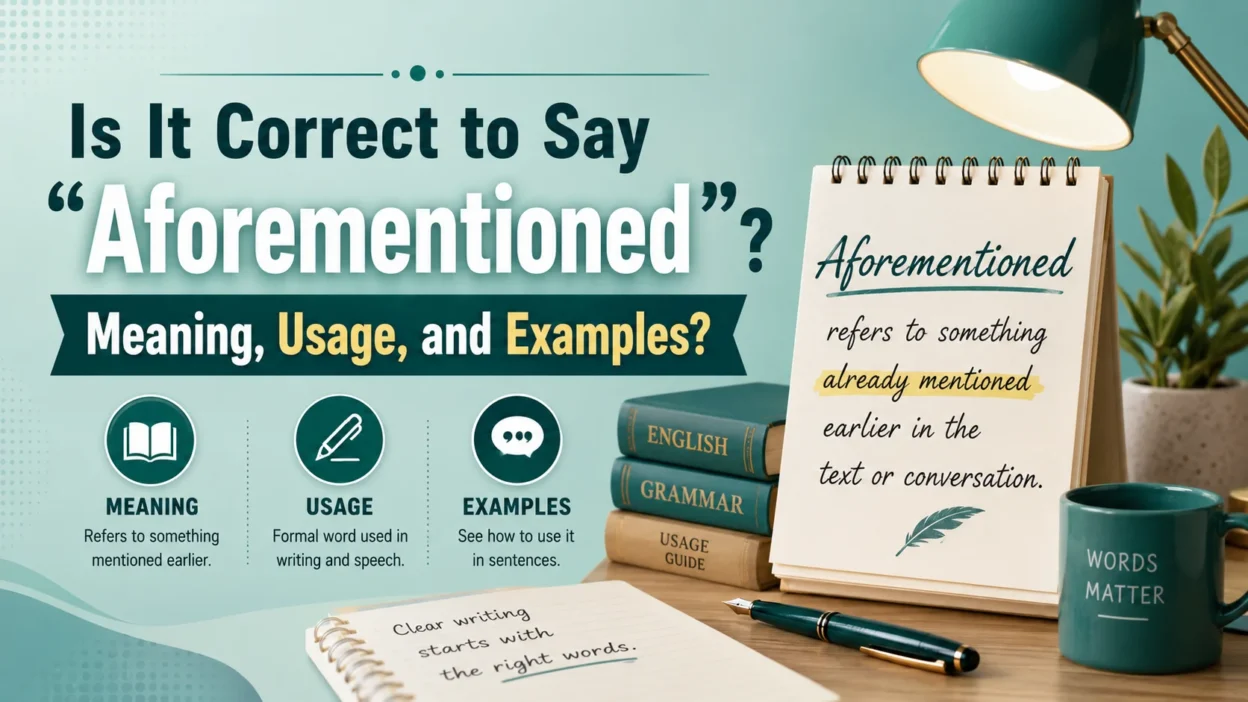
Is It Correct to Say “Aforementioned”? Yes, aforementioned is a formal expression used in English language writing to refer to something already mentioned in a text or conversation. It’s common in professional writing, emails, essays, contracts, academic papers, and legal documents. Although some writers find its formal tone stiff or awkward, it can provide clarity, precision, and a polished tone when used with the right context and intended audience.
The key is to know when and how to use aforementioned. It works as an adjective before a noun and refers to something previously mentioned or already introduced. For example, an aforementioned report can refer back to a report discussed earlier. Good grammatical usage improves sentence structure, reader understanding, and effective communication. However, common mistakes can make your writing sound unnecessarily formal.
In casual conversations and relaxed settings, simpler alternatives may sound more natural, such as mentioned above, I said earlier, or as mentioned before. When choosing between these options, consider the situation, style, and purpose of your sentence. In my experience, the best choice depends on whether you need professionalism, clarity, or a friendly tone.
What Does “Aforementioned” Mean?
Simple Definition of “Aforementioned”
Aforementioned refers to a person, thing, idea, or subject that appeared earlier in a text or discussion.
For example:
Sarah submitted the report on Monday. The aforementioned report contained several errors.
Here, aforementioned report means the report mentioned earlier.
The word usually appears directly before a noun:
- the aforementioned report
- the aforementioned agreement
- the aforementioned employee
- the aforementioned studies
- the aforementioned issues
Is “Aforementioned” a Formal Word?
Yes. Cambridge labels it formal, which explains why it can sound unusual in casual speech.
You might see:
The aforementioned documents must be submitted by Friday.
But in everyday English, most people would say:
The documents mentioned earlier must be submitted by Friday.
Or simply:
These documents must be submitted by Friday.
The meaning stays nearly the same. The tone changes.
Is “Aforementioned” Grammatically Correct?
Yes, “Aforementioned” Is Correct
There is nothing grammatically wrong with aforementioned. It is a standard English adjective.
The important rule is that the noun it describes must have been mentioned previously.
Correct:
The company introduced a new policy. The aforementioned policy takes effect next month.
Incorrect or unclear:
The company introduced a new policy. The aforementioned report contains several errors.
Why is the second example confusing? The report wasn’t mentioned earlier.
Why Do Some Writers Avoid It?
The problem isn’t grammar. It’s clarity and tone.
Modern plain-language guidance encourages writers to choose familiar words instead of unnecessary jargon. Canada’s official writing guidance specifically recommends replacing aforementioned with alternatives such as previously, earlier, above, this, that, these, and those.
U.S. government writing guidance also emphasizes short sections, familiar words, active voice, and clear communication for the intended audience.
So, correct doesn’t always mean ideal.
When Should You Use “Aforementioned”?
Legal Documents
Legal writing is one place where aforementioned commonly appears.
The parties agree to comply with the aforementioned provisions.
The word can point readers toward provisions already identified in a lengthy document.
However, even legal writers increasingly value plain language. Canada’s writing guidance specifically advises avoiding aforementioned and above-mentioned when simpler wording works.
Academic Writing
You can use aforementioned in academic papers, essays, and research writing.
The aforementioned studies support the proposed theory.
Still, this may be clearer:
These studies support the proposed theory.
Academic writing doesn’t become stronger simply because it sounds more formal. Precision and readability matter more.
Business Reports
Formal reports sometimes use the word to refer back to a proposal, policy, or agreement.
Management approved the aforementioned proposal.
A simpler version might be:
Management approved the proposal discussed earlier.
If the reference is obvious, this is even cleaner:
Management approved the proposal.
Technical Writing
Technical documents may use aforementioned when referring to a specific setting, component, or procedure.
The aforementioned configuration controls the authentication process.
However, technical readers usually benefit from direct references:
This configuration controls the authentication process.
The second sentence is shorter and easier to scan.
When Should You Avoid “Aforementioned”?
Everyday Conversations
Technically, you could say:
Please pass me the aforementioned coffee mug.
But that sounds intentionally formal.
A natural speaker would say:
Please pass me that coffee mug.
That’s the difference between grammatical correctness and natural usage.
Blog Posts
Online readers generally benefit from clear, familiar language.
Instead of:
The aforementioned tips can improve your writing.
Try:
These tips can improve your writing.
The second sentence reaches the point faster.
Marketing Content
Marketing copy should usually sound direct and approachable.
Weak:
Customers can purchase the aforementioned product online.
Better:
You can buy the product online.
Plain-language guidance consistently recommends simple, direct wording when it communicates the same idea.
Emails and Social Media
Most emails don’t need aforementioned.
Instead of:
Please review the aforementioned report.
Write:
Please review the report.
If you need to identify it:
Please review the report we discussed earlier.
Social media calls for even simpler language:
This offer ends tomorrow.
There’s no need for:
The aforementioned offer ends tomorrow.
“Aforementioned” Examples in Real Writing
| Context | Formal Example | Natural Alternative |
| Legal | The aforementioned provisions apply. | These provisions apply. |
| Academic | The aforementioned studies support this view. | These studies support this view. |
| Business | The aforementioned proposal was approved. | The proposal was approved. |
| Technical | The aforementioned setting controls access. | This setting controls access. |
| Please review the aforementioned report. | Please review the report. | |
| Blog | The aforementioned tips are useful. | These tips are useful. |
The table reveals an important pattern: the simpler alternative often removes words without removing meaning.
Common Mistakes With “Aforementioned”
1. Using It Without a Clear Reference
The aforementioned issue needs attention.
If the reader doesn’t know which issue you mean, the word creates confusion.
Always make the earlier reference obvious.
2. Referring to Several Items
Imagine a paragraph discusses a budget, marketing plan, and staffing proposal.
Then you write:
The aforementioned plan was approved.
Which plan?
When several possible references exist, name the exact item:
The staffing proposal was approved.
Specific wording beats vague backward references.
3. Overusing “Aforementioned”
This sentence sounds heavy:
The aforementioned policy affects the aforementioned employees under the aforementioned conditions.
A cleaner version is:
This policy affects employees under these conditions.
Good writing doesn’t make readers repeatedly walk backward through the paragraph.
4. Using It Informally
I tried the aforementioned burger yesterday.
It’s grammatically fine. It just sounds oddly formal.
Natural:
I tried that burger yesterday.
Better Alternatives to “Aforementioned”
There isn’t one perfect replacement. Choose according to context.
| Alternative | Best Use |
| mentioned earlier | General writing |
| previously mentioned | Formal but readable writing |
| earlier | Short references |
| this | Nearby singular reference |
| that | Specific previous item |
| these | Nearby plural items |
| those | Earlier plural items |
| the above | Structured documents |
For example:
The aforementioned recommendations should be followed.
Could become:
The recommendations mentioned earlier should be followed.
Or:
These recommendations should be followed.
Usually, these recommendations sounds the most natural when the reference is obvious.
“Aforementioned” vs. “Previously Mentioned”
These phrases have essentially the same core meaning.
Aforementioned is more formal and compact.
Previously mentioned is more transparent.
The aforementioned report contains new data.
The previously mentioned report contains new data.
Both are correct. The second usually feels less stiff.
“Aforementioned” vs. “Earlier”
Earlier is shorter and often more conversational.
The aforementioned agreement needs revision.
The earlier agreement needs revision.
However, earlier can become vague when several agreements appear in the discussion.
In that situation, name the agreement:
The 2026 service agreement needs revision.
That removes ambiguity completely.
“Aforementioned” vs. “Above-Mentioned”
These expressions are very similar.
The aforementioned documents are available online.
The above-mentioned documents are available online.
Both refer to documents mentioned earlier. Both also have a formal tone.
Canada’s official writing guidance recommends replacing both terms with clearer alternatives such as previously, earlier, above, this, that, these, or those.
Why Modern Writers Often Avoid “Aforementioned”
The modern preference for plain language isn’t about making writing simplistic. It’s about making information quick to understand.
Digital.gov recommends shorter words, shorter sections, active voice, and familiar language when writing for an audience.
Consider:
The aforementioned recommendations should be implemented immediately.
Now compare:
These recommendations should be implemented immediately.
The second version removes unnecessary formality while keeping the meaning intact.
The National Archives similarly recommends simple, direct words and advises writers to remove needless wording.
A Quick Before-and-After Example
Before:
Based on the aforementioned findings, the aforementioned strategy should be revised.
After:
Based on these findings, the strategy should be revised.
The second version is shorter, smoother, and easier to process.
Should You Use “Aforementioned” in Professional Writing?
Yes, when the context genuinely calls for formal language.
It’s acceptable in:
- Legal documents
- Formal contracts
- Academic papers
- Government documents
- Technical reports
- Formal business writing
But don’t use it simply to make your writing sound intelligent.
Professional writing works best when readers can understand the message without stopping to decode the wording.
As the U.K. government’s writing guidance notes, even highly educated and specialist readers often prefer plain English when a clear alternative exists.
Quick Usage Guide
| Situation | Recommendation |
| Legal contract | Use when appropriate |
| Academic essay | Acceptable |
| Research paper | Acceptable |
| Technical report | Sometimes useful |
| Business report | Use sparingly |
| Professional email | Usually avoid |
| Blog post | Usually avoid |
| Marketing copy | Avoid |
| Social media | Avoid |
| Casual conversation | Avoid |
The Simple Rule
Before using aforementioned, ask yourself:
“Would this sentence be clearer if I used this, these, earlier, or the actual noun?”
If yes, choose the simpler option.
Conclusion
Aforementioned is a correct and useful word when you need to refer to something previously mentioned, especially in formal writing. It works well in professional contexts, academic papers, contracts, and official documents. However, in casual conversations, simpler alternatives such as mentioned above or I said earlier may sound more natural. The best choice depends on your audience, context, and writing style.
FAQs
Q1. Is it correct to say “aforementioned”?
Yes, aforementioned is grammatically correct. It refers to something that was mentioned earlier in a text or discussion.
Q2. Is “aforementioned” formal?
Yes. Aforementioned has a formal tone and is commonly used in academic, legal, professional, and official writing.
Q3. Can I use “aforementioned” in casual conversation?
You can, but it may sound stiff or overly formal. In casual speech, mentioned earlier or mentioned above often sounds more natural.
Q4. What does “aforementioned” mean?
Aforementioned means something that was previously mentioned or discussed earlier in a text or conversation.
Q5. What are some alternatives to “aforementioned”?
Common alternatives include mentioned above, mentioned earlier, previously mentioned, as noted earlier, and I said earlier.