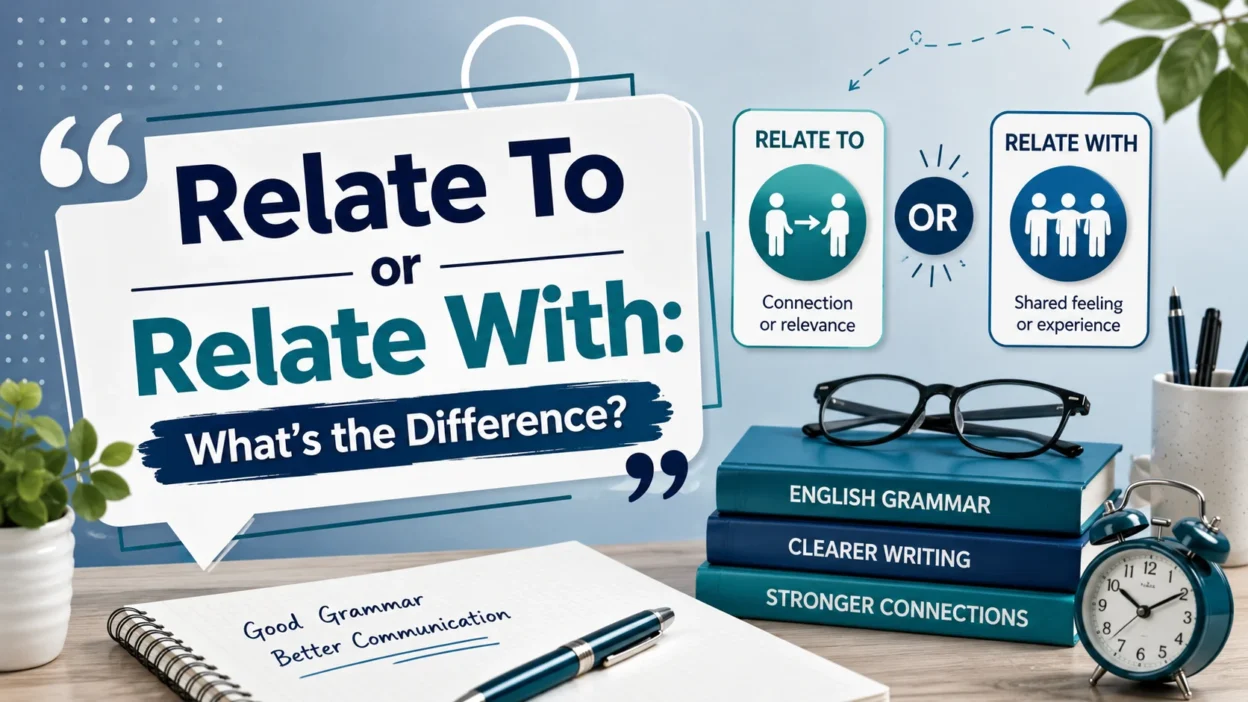
Relate to or Relate With can confuse English learners because both phrases may look interchangeable. In standard modern English, Relate To is the preferred choice when you want to express a connection to someone’s experience, an idea, or a situation. It sounds more natural in everyday English, conversational English, and real-life communication. Understanding this difference, preposition usage, and context can improve your communication skills and make your English more precise.
Relate To can show a personal connection with an experience or a relationship with a subject, topic, rule, or idea. Relate With may appear in some usage, but it isn’t the usual standard form. Paying attention to expressions, prepositions, natural English, and proper usage helps students avoid confusion. Listening to real conversations and studying practical examples can build stronger language skills, language proficiency, and fluent communication.
The key is to consider context, communication goals, and the intended meaning. If you mean understanding or identifying with someone’s feelings or experience, choose Relate To. The same phrase can also describe a connection between information and a subject. This simple grammatical distinction makes your writing, sentences, and everyday communication more authentic, effective, and natural..
Quick Answer: Relate To or Relate With?
Use relate to when you mean understand, identify with, connect to, or be associated with something or someone.
Use:
- I can relate to your experience.
- She relates to the main character.
- This information relates to the topic.
- The rule relates to all employees.
Relate with can be understood, and it does appear in some English usage. Still, it isn’t the standard expression for the common meaning of identifying with or understanding someone.
| Expression | Main use | Example |
| Relate to | Understand or identify with | I can relate to your experience. |
| Relate to | Have a connection with | This rule relates to workplace safety. |
| Relate with | Less common usage | Some speakers use it instead of “relate to.” |
| Connect with | Form or feel a connection | I connect with her message. |
| Empathize with | Understand someone’s feelings | I empathize with his situation. |
The simplest rule is this: when you mean “I understand or identify with it,” use “relate to.”
What Does “Relate” Mean?
The word relate has several meanings, which explains why its usage can sometimes feel tricky.
In everyday English, relate often describes the ability to understand someone’s experience because you’ve experienced something similar. It can also describe a connection between ideas, subjects, events, or facts.
Definition of “Relate”
As a verb, relate can mean:
- to understand or identify with someone or something
- to have a connection with something
- to concern or involve something
- to tell or describe an event or story
- to interact or form a relationship with someone
Consider these examples:
I can relate to her frustration.
Here, relate to means understand or identify with.
The article relates to workplace safety.
Here, relates to means concerns or is connected with.
He related the story to his friends.
Here, related means told or described.
The context determines the meaning.
Why the Preposition Matters
English uses many fixed verb-preposition combinations. You can’t always replace one preposition with another and expect the sentence to sound natural.
For example:
- listen to music
- depend on someone
- agree with someone
- believe in something
- relate to someone
- connect with someone
That’s why relate to feels natural to most English speakers while relate with can sound unusual.
Is “Relate To” or “Relate With” Correct?
For standard American English, relate to is the preferred expression when you’re talking about understanding, identifying with, or having a connection to something.
Why “Relate To” Is the Standard Expression
The phrase relate to has two especially common uses.
First, it can describe a personal or emotional connection:
I can relate to your situation.
Second, it can describe a factual or logical connection:
This evidence relates to the investigation.
Dictionary sources such as Merriam-Webster and Cambridge Dictionary document these uses of relate to, including meanings involving connection, relevance, understanding, and identification.
Why People Say “Relate With”
The phrase relate with may sound reasonable because English contains several similar expressions that use with.
For example:
- connect with someone
- identify with someone
- empathize with someone
- interact with someone
- agree with someone
A speaker may naturally transfer that pattern to relate and say relate with.
The meaning is usually clear from context. Still, clarity doesn’t necessarily make a phrase the preferred standard construction.
Is “Relate With” Ever Correct?
Relate with does appear in real-world English, particularly in informal or regional usage. However, it isn’t the usual standard construction for the meaning “understand or identify with.”
That’s an important distinction.
It would be too broad to claim that nobody ever uses relate with. English varies across speakers and communities. However, if you’re learning standard American English or writing for a professional audience, relate to is the better choice.
“Relate To” Meaning Explained
The phrase relate to covers more than emotional understanding.
Understanding Someone’s Feelings or Experiences
When you say “I can relate to you,” you’re usually saying that you understand the person’s experience because something similar has happened to you.
For example:
I can relate to the stress of starting a new job.
This statement suggests personal familiarity. The speaker isn’t merely saying that they understand the definition of stress. They recognize the experience.
Compare these two sentences:
- I understand your frustration.
- I can relate to your frustration.
Understand is broader. Relate to often suggests personal recognition or shared experience.
Showing a Logical or Personal Connection
Relate to can also describe a relationship between facts, ideas, subjects, or events.
For example:
This chapter relates to consumer behavior.
The evidence relates to the main argument.
How does this information relate to the question?
In these examples, the phrase has nothing to do with empathy. It simply means be connected to, concern, or have relevance to something.
Common Situations Where “Relate To” Is Used
You can use relate to with:
- people
- feelings
- experiences
- stories
- characters
- ideas
- subjects
- problems
- research
- policies
- events
For example:
Many students can relate to the pressure of exams.
This section relates to workplace communication.
I really relate to that character.
“Relate With” Meaning and Usage
Because relate with exists in actual usage, it deserves a balanced explanation.
Why “Relate With” May Sound Natural
People often combine familiar patterns in English.
Someone may know:
I connect with this story.
and:
I identify with this character.
They may then produce:
I relate with this character.
The intended meaning remains understandable. However, I relate to this character is the standard and more widely accepted construction.
Is “Relate With” Standard American English?
For the common meaning of understanding or identifying with someone, relate with isn’t the preferred standard construction in American English.
If you’re writing formal or polished content, choose relate to.
For example:
Less standard:
I can relate with your experience.
Standard:
I can relate to your experience.
The second sentence is more natural and avoids unnecessary uncertainty.
What Should You Use Instead?
Choose the expression that matches your exact meaning.
- Use relate to for understanding or identifying with something.
- Use connect with for forming a personal or emotional connection.
- Use empathize with when focusing on another person’s feelings.
- Use identify with when you see yourself in another person or character.
Precision makes writing stronger.
Relate To or Relate With: Side-by-Side Comparison
| Point | Relate To | Relate With |
| Standard usage | Yes | Less common |
| Understand an experience | Yes | Not preferred |
| Identify with someone | Yes | Less standard |
| Show a logical connection | Yes | Not normally used |
| Formal writing | Recommended | Avoid when possible |
| Academic writing | Recommended | Better replaced |
| Everyday conversation | Very natural | May occur |
| Best choice for learners | Yes | No |
If you only remember one thing, remember this:
Relate to is the standard choice.
Examples of “Relate To” in Sentences
Everyday Examples
- I can relate to your frustration.
- She can relate to people who feel nervous in crowds.
- I really relate to this story.
- Many parents can relate to that situation.
- He relates to the character’s struggles.
Professional Examples
- This policy relates to all employees.
- The complaint relates to a billing issue.
- These figures relate to last year’s sales.
- The new rules relate to workplace safety.
Academic Examples
- The study relates to language development.
- These findings relate to the research question.
- The evidence relates directly to the proposed theory.
- This section relates the results to previous research.
Emotional Examples
- I can relate to how you’re feeling.
- She relates strongly to the character’s loneliness.
- Many teenagers can relate to the pressure of fitting in.
- I couldn’t relate to his experience.
Examples of “Relate With” in Sentences
If you encounter relate with, the intended meaning will usually be clear. However, standard American English generally favors relate to in these situations.
| Less-preferred version | Preferred version |
| I can relate with your experience. | I can relate to your experience. |
| She relates with the character. | She relates to the character. |
| We relate with their struggles. | We relate to their struggles. |
| I relate with what you’re saying. | I relate to what you’re saying. |
This isn’t about declaring every occurrence of relate with impossible. It’s about choosing the construction that gives you the strongest standard usage.
Common Mistakes With Relate To and Relate With
Using “Relate With” Instead of “Relate To”
The easiest mistake to fix is replacing with with to.
❌ I can relate with your problem.
✅ I can relate to your problem.
Confusing “Relate To” With “Connect With”
These expressions overlap, but they aren’t identical.
Relate to often focuses on understanding or recognizing something familiar:
I relate to her experience.
Connect with often emphasizes emotional or personal connection:
I connect with her message.
The right phrase depends on the idea you want to express.
Confusing “Relate To” With “Empathize With”
Empathize with focuses specifically on understanding another person’s feelings.
I empathize with his situation.
Relate to often suggests personal familiarity.
I relate to his situation because I’ve experienced something similar.
Mixing Different Meanings of “Relate”
Don’t confuse relate to with the transitive verb relate, which can mean “tell” or “describe.”
She related the story to her friends.
Here, related means told.
But:
She related to the story.
Here, related to means identified with or understood the story.
The structure changes the meaning.
The Grammar Behind “Relate To”
Why “To” Is Used With “Relate”
When relate means to have a connection with or identify with something, English normally uses to.
Common patterns include:
- relate to someone
- relate to an experience
- relate to an idea
- relate to a topic
- relate to a problem
This pattern is established in standard dictionary usage.
Does “Relate” Always Need “To”?
No.
For example:
She related the story.
Here, relate means tell.
You can also say:
He relates well to children.
This describes someone’s ability to interact or form a relationship with others.
So the rule isn’t “relate must always be followed by to.” Instead, the meaning and sentence structure determine what follows the verb.
How to Remember Relate To
Here’s an easy memory trick:
Relate TO = recognize a connection TO something.
Use it when you mean:
- understand
- identify with
- recognize a shared experience
- have a connection with
- concern or involve
For example:
I can relate to that.
This rule relates to employees.
She relates to the character.
If you mean emotional connection in a different sense, connect with may be more precise:
I connect with the speaker’s message.
Quick Practice: Relate To or Relate With?
Choose the correct expression:
- I can ___ your frustration.
- This rule ___ all employees.
- She really ___ the main character.
- The study ___ language development.
- I can ___ what you’re saying.
Answers
- relate to
- relates to
- relates to
- relates to
- relate to
Once you recognize the pattern, the choice becomes much easier.
Conclusion
Choosing between Relate To and Relate With becomes easier once you understand the context. In standard American English, Relate To is the preferred choice when you mean understanding, identifying with, or having a connection to someone or something. Relate With may appear in informal usage, but Relate To remains the clearer and more natural option for everyday, academic, and professional writing.
FAQs
Q1. Is “Relate To” or “Relate With” correct?
Relate To is the standard choice in most situations. Use it when you mean understanding, identifying with, or having a connection to someone or something.
Q2. Can I say “I relate with you”?
You can find relate with in informal usage, but “I can relate to you” is the more natural and standard expression in American English.
Q3. What does “I can relate to you” mean?
It means you understand someone’s feelings or experience because you’ve experienced something similar yourself.
Q4. Why do people confuse “Relate To” and “Relate With”?
The confusion often comes from similar expressions such as connect with, identify with, and empathize with. These phrases use with, while the standard expression is relate to.
Q5. Is “Relate To” suitable for formal writing?
Yes. Relate To works well in academic, professional, and formal writing. It can describe either a personal connection or a relationship between ideas, topics, facts, or events.