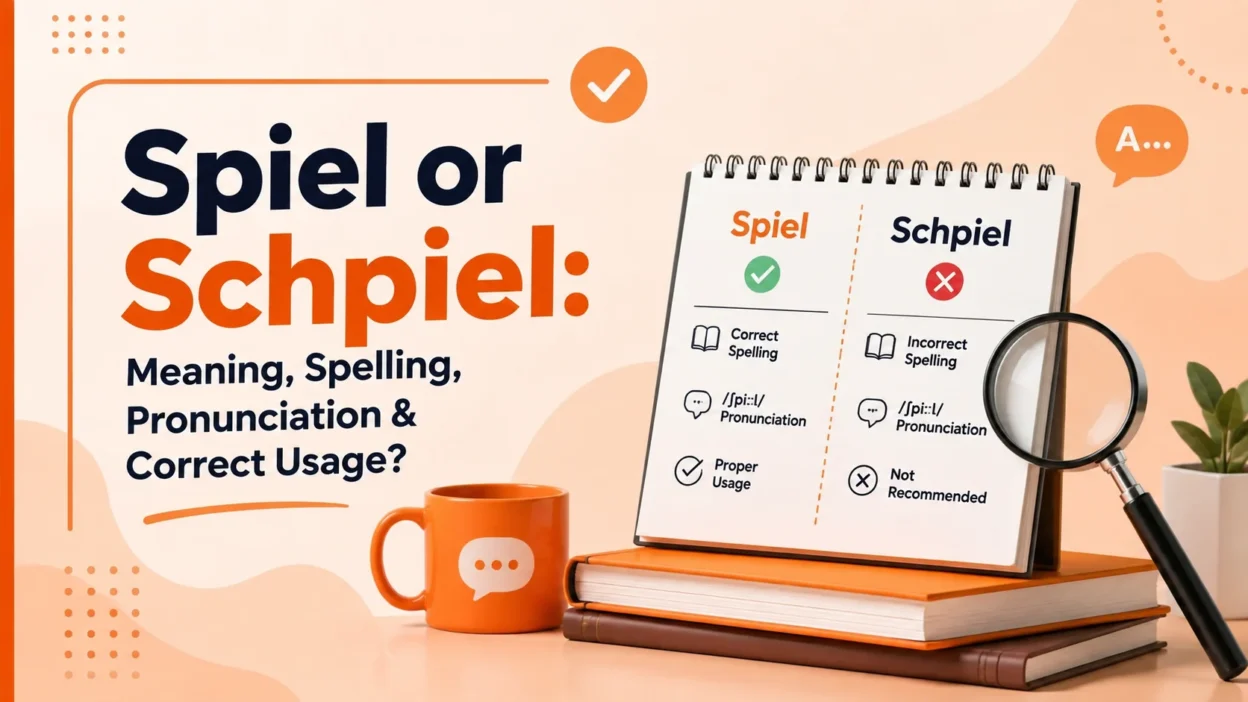
Spiel or Schpiel can confuse English learners because both have a similar sound, but Spiel is the widely accepted spelling in modern English. Schpiel is an informal variation and alternative spelling influenced by Yiddish pronunciation, culture, and German roots. Their origins, history, and etymology show how language evolution, borrowing words, and reshaping words create easily confused words. The meaning of spiel, or what does spiel mean, becomes clear through contextual meaning, semantic meaning, and usage trends.
The difference between spiel and schpiel mainly involves spelling variation and linguistic variation, while both can express the same idea. In conversation, a sales pitch, monologue, patter, lengthy speech, or verbal pitch may be called a spiel. Using the correct spelling, correct usage, and right spelling improves confidence in writing, word choice, and professional communication. A practical guide with examples can prevent confusion, mistakes, and misinterpretation.
Strong Reasoning, Clear thinking, Deductive reasoning, and Inductive reasoning help with choosing the right word, Analysis, Understanding, and Problem solving. Through Practical examples, Research, and Academic learning, you can develop better Skills and Meaningful interpretation. A salesperson may use a rehearsed sales pitch to persuade people about a product, while pop culture may provide useful references. Learning these usage rules makes your English spelling and communication more effective.
What Does Spiel Mean?
Spiel is a noun that usually refers to a practiced, persuasive, or lengthy piece of speech. Cambridge Dictionary specifically associates it with speech intended to persuade the listener, such as a sales spiel.
The word often suggests that someone has delivered the same basic message many times.
Imagine a salesperson explaining the same product to dozens of customers. The explanation may include the same benefits, features, price information, and promotional language each time. That prepared presentation can be called a spiel.
The word doesn’t always imply dishonesty, though. Context matters.
For example:
“The tour guide gave us an interesting spiel about the history of the building.”
That sentence can simply describe a prepared explanation. By contrast:
“I’ve heard that spiel before.”
Here, the speaker probably sounds skeptical or annoyed.
Common Meanings of Spiel
The main uses include:
- Sales pitch: A prepared attempt to persuade someone to buy something.
- Promotional speech: Language designed to make a product, service, or idea attractive.
- Rehearsed explanation: A familiar explanation repeated in similar situations.
- Persuasive talk: Speech intended to influence someone’s opinion or decision.
- Lengthy talk: A relatively long explanation that may feel excessive.
- Extravagant talk: Language that sounds polished, exaggerated, or overly elaborate.
The closest meaning depends on the sentence. In one situation, spiel may mean pitch. In another, prepared explanation may be more accurate.
How Do You Pronounce Spiel?
The common pronunciation of spiel is “shpeel.”
Cambridge gives the pronunciation /ʃpiːl/ in both its UK and US entries. Its American dictionary also records /spil/ as another pronunciation.
The pronunciation can therefore be represented like this:
spiel → shpeel
The first sound resembles the “sh” in ship. The remaining part sounds like peel.
Pronunciation Breakdown
| Part | Sound | Explanation |
| sp | /ʃp/ | Commonly heard as “shp” |
| ie | /iː/ | Long “ee” sound |
| l | /l/ | Final “l” sound |
| spiel | /ʃpiːl/ | Approximately “shpeel” |
The pronunciation helps explain why some people write schpiel. If someone hears “shpeel,” adding sch may seem logical because German uses sch for the “sh” sound.
German pronunciation provides an especially useful clue. Duden gives spielen as [ˈʃpiːlən], showing the same initial “shp” sound.
Spiel or Schpiel: Which Spelling Is Correct?
When you’re writing in standard English, spiel is the better choice.
The word appears as the established English dictionary form. Cambridge Dictionary uses spiel as its headword and provides its English definition and pronunciation.
Schpiel is encountered as an alternative spelling, particularly in informal contexts. It can make sense phonetically because sch visually represents the “sh” sound in German-influenced spelling.
Still, that doesn’t make schpiel the preferred spelling for general English.
If you’re writing a:
- Blog post
- Business document
- Resume
- School assignment
- News article
- Professional report
Spiel is the safest form.
Is Schpiel a Misspelling?
Calling schpiel simply a spelling error doesn’t capture the whole picture.
The form exists because writers sometimes adapt the spelling to match pronunciation or linguistic influence. It isn’t the standard form you should reach for in ordinary English writing, though.
The distinction is useful:
Spiel = established standard English spelling
Schpiel = alternative or less common spelling
If clarity is your goal, there’s little reason to choose the longer spelling.
Spiel or Schpiel Comparison Table
| Feature | Spiel | Schpiel |
| Standard English spelling | Yes | No |
| Common English form | Yes | Less common |
| Pronunciation | Usually “shpeel” | Usually “shpeel” |
| Basic English meaning | Rehearsed or persuasive talk | Same general sense |
| Professional writing | Recommended | Usually avoid |
| Informal writing | Common | Possible |
| Why it causes confusion | Spelling doesn’t clearly show “sh” | Spelling reflects “sh” sound |
The biggest difference isn’t meaning. It’s standard spelling and frequency.
Where Did the Word Spiel Come From?
The history of spiel is connected to Germanic languages.
The German word Spiel has a much broader meaning than the modern English word. German Spiel relates to concepts such as play and games, while the verb spielen means “to play” and has numerous uses. Duden traces spielen to Middle High German spiln and Old High German spilōn.
English eventually adopted a related form and developed its own meaning.
This is a common pattern in language. Borrowed words don’t always retain every aspect of their original meaning. Once a word enters another language, speakers reshape it according to their own vocabulary, pronunciation, and cultural context.
From German to English
The historical connection can be simplified like this:
| Stage | Development |
| Old High German | spilōn |
| Middle High German | spiln |
| German | spielen / Spiel |
| English | spiel |
| Modern English | Rehearsed, persuasive, or elaborate talk |
The modern English meaning is therefore more specific than the broad German idea of play.
Why Does the Spelling “Schpiel” Exist?
The spelling schpiel is easy to understand once pronunciation enters the picture.
German uses sch for the sound represented by English sh. Duden’s pronunciation of spielen begins with /ʃ/, confirming that German pronunciation uses this sound.
Someone who hears “shpeel” might naturally reason:
“If it sounds like shpeel, why not spell it schpiel?”
That’s a reasonable guess, but English spelling doesn’t always follow pronunciation that closely.
The established English spelling retained spiel, even though many speakers pronounce it with the “sh” sound.
Why Some Writers Use Schpiel
Several factors can encourage the spelling:
- Phonetic spelling: The writer wants the spelling to show the pronunciation.
- German influence: The sch combination looks familiar from German words.
- Informal usage: Casual writing often produces alternative spellings.
- Cultural influence: Different linguistic communities can preserve or popularize variant forms.
- Pronunciation confusion: People may assume the spelling should directly represent the “sh” sound.
None of these reasons makes schpiel the best default for standard English.
How Is Spiel Used in Modern English?
Modern English uses spiel most often when describing prepared, persuasive, repetitive, or elaborate speech.
The word has a particularly strong connection with selling and persuasion. Cambridge Dictionary labels it informal and disapproving and gives sales spiel as a typical example.
That negative tone isn’t mandatory, though.
Positive or Neutral Usage
Consider:
“The instructor gave a clear spiel about the new safety procedures.”
The speaker may simply mean a prepared explanation.
Another example:
“She had a short spiel prepared for new customers.”
This sentence emphasizes preparation rather than deception.
Negative Usage
Now consider:
“I don’t want to hear another spiel about why the price went up.”
Here, spiel suggests that the explanation feels repetitive or unconvincing.
Likewise:
“The politician repeated the same old spiel.”
The speaker clearly doesn’t admire the message.
Context creates much of the word’s emotional force.
Real-Life Examples of Spiel
Sales
“The salesperson launched into a spiel about the benefits of the premium package.”
This is one of the most natural uses because sales presentations are often prepared and repeated.
Tourism
“Our guide gave the usual spiel about the city’s oldest landmark.”
A tour guide may repeat essentially the same historical explanation to every group.
Politics
“Voters have heard the same political spiel throughout the campaign.”
Here, the word suggests familiar talking points and repeated messaging.
Customer Service
“The representative gave me the standard spiel about the company’s return policy.”
The phrase standard spiel strongly emphasizes a prepared explanation.
Entertainment
“Before the performance, the host delivered his usual spiel.”
The host may have a familiar introduction that appears at every show.
Spiel or Speech: What’s the Difference?
Speech is a much broader word.
A speech can be formal, informal, emotional, educational, political, ceremonial, or spontaneous. It doesn’t automatically tell you anything about the speaker’s intentions.
Spiel, however, often suggests something more specific.
It can imply:
- Repetition
- Preparation
- Persuasion
- Promotion
- Length
- Familiar talking points
- Exaggeration
Compare these two sentences:
“She gave a speech about the company’s future.”
This statement is neutral.
“She gave the usual spiel about the company’s future.”
Now the speaker suggests that the message was familiar, rehearsed, or perhaps unconvincing.
That’s the key distinction.
Spiel or Pitch: What’s the Difference?
Pitch and spiel overlap heavily, especially in sales.
A pitch usually focuses on persuasion. A salesperson pitches a product because they want the customer to take action.
A spiel can also persuade, but it often emphasizes the prepared or repetitive nature of the talk.
For example:
“He gave investors a pitch for his startup.”
The focus is persuasion.
“He gave investors the same spiel he had used at three other meetings.”
The focus is repetition.
Neither word is automatically better. Choose the one that matches the meaning you want.
Common Mistakes With Spiel
Using Schpiel as the Default Spelling
If you want conventional English spelling, use spiel.
Assuming Spiel Always Means Sales Pitch
Sales are a common context, but political speeches, promotional explanations, tour-guide remarks, and repeated excuses can also be called spiel.
Assuming Spiel Is Always Insulting
It can be neutral. The surrounding words determine whether the speaker sounds approving, indifferent, skeptical, or annoyed.
Pronouncing It Only as “Speel”
The pronunciation /ʃpiːl/, or “shpeel,” is widely recognized. Cambridge also records /spil/ in its American dictionary entry.
Is Spiel Appropriate in Formal Writing?
Spiel is a legitimate English word, but it has an informal flavor.
If you’re writing a casual article, feature story, opinion piece, or conversational business message, it can work naturally.
For academic or highly formal writing, a more precise word may communicate the idea better.
Depending on context, alternatives include:
- Presentation
- Prepared remarks
- Explanation
- Sales presentation
- Promotional message
- Persuasive argument
- Talking points
For example:
Informal: “The company gave customers the usual marketing spiel.”
More formal: “The company presented its standard marketing message.”
The first sentence has more personality. The second sounds more detached and formal.
A Simple Case Study: A Rehearsed Sales Spiel
Imagine a software company launches a new subscription plan.
Its sales team receives a prepared explanation covering:
- The monthly price
- The main features
- Customer benefits
- A promotional discount
- Reasons to upgrade
Every salesperson changes the wording slightly, but the message remains basically the same.
A manager might tell the team:
“Learn the new spiel before Friday’s calls.”
Here, spiel means a prepared sales presentation.
Later, a customer hears the same explanation from several representatives and responds:
“I’ve heard that spiel already. Just tell me the actual price.”
Now the word carries a negative tone.
The fascinating part is that the basic meaning hasn’t changed. The context changes the attitude.
Spiel or Schpiel: Quick Reference
| Question | Answer |
| Which spelling is standard? | Spiel |
| How is it commonly pronounced? | “Shpeel” |
| What does it mean? | A practiced, persuasive, lengthy, or elaborate piece of talk |
| Is it only a sales term? | No |
| Can it describe political messaging? | Yes |
| Can it describe a prepared explanation? | Yes |
| Is schpiel used? | Yes, as a less common alternative spelling |
| Should you normally write schpiel? | No |
| Is spiel suitable for casual writing? | Yes |
| Can spiel have a negative tone? | Yes |
Conclusion
Spiel is the standard and widely accepted spelling in modern English, while Schpiel is an alternative spelling influenced by Yiddish pronunciation. Although both forms may refer to the same idea, using Spiel is the safer choice in formal writing, professional communication, and everyday English.
FAQs
Q1. Is Spiel or Schpiel correct?
Spiel is the standard and preferred spelling in English. Schpiel is an informal alternative spelling.
Q2. What does Spiel mean?
Spiel usually means a lengthy speech, sales pitch, rehearsed explanation, or persuasive talk.
Q3. Is Schpiel a misspelling?
Schpiel is generally treated as an alternative or less standard spelling of Spiel.
Q4. How do you pronounce Spiel?
Spiel is commonly pronounced like “shpeel.”
Q5. Should I use Spiel in formal writing?
Yes. Spiel is the better choice for formal writing, professional communication, and standard English usage.