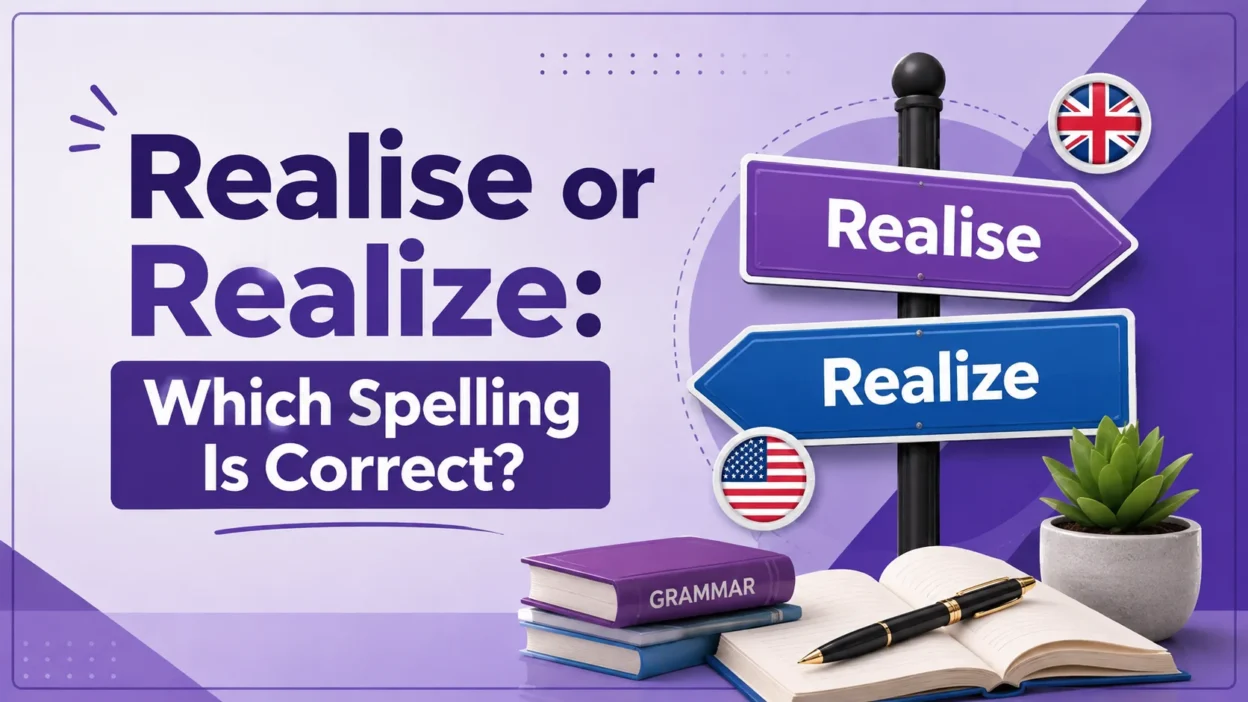
‘Realise’ or ‘Realize’ can be confusing because both forms are correct, have the same meaning, and sound the same. Realise is preferred in British English, while realize is favored in American English. Both are widely used across the English-speaking world, including the United States, Canada, Australia, New Zealand, and the United Kingdom.
As a verb, both forms have derivatives such as realised, realized, realising, realizing, realisation, and realization. They describe becoming aware of a fact or coming to understand something clearly. The best rule is to choose the spelling that matches your audience and use it consistently.
English spelling also reflects historical patterns and etymological influences from Greek and Latin traditions. Sources such as Oxford, Cambridge, Collins, Google Books, and ngram show changing usage and preferences. Whether you’re writing emails, essays, blogs, or social media, consistency improves communication and writing accuracy.
Realise or Realize: The Quick Answer
Realize and realise are the same verb. They have the same core meanings and differ only in spelling.
| English variety | Common spelling |
| American English | realize |
| British English | realise is commonly preferred |
| Oxford-style British English | realize |
| Australian English | realise is commonly used |
| New Zealand English | realise is commonly used |
For American writing, realize is the clear choice. For British writing, check the publication or style guide because both realise and realize can appear.
Realise or Realize Example Sentences
American English:
I didn’t realize how difficult the task would be.
British English:
I didn’t realise how difficult the task would be.
The meaning remains unchanged.
You can see the same pattern in other sentences:
- She realized that she had made a mistake.
- She realised that she had made a mistake.
- We didn’t realize the store was already closed.
- We didn’t realise the store was already closed.
- He finally realized his dream.
- He finally realised his dream.
The only visible difference is the letter s or z.
What Does Realize or Realise Mean?
The verb realize commonly means to become aware of something or understand it, sometimes suddenly. Cambridge also lists meanings connected with achieving a goal and obtaining a particular amount from a sale.
For example:
I suddenly realized that I’d left my phone at home.
Here, realized means became aware.
The word can also describe achieving something you’ve wanted:
She finally realized her ambition of becoming a doctor.
In finance, realize has a more specialized meaning. An asset can realize a particular amount when it is sold.
Examples of Realize or Realise in Context
The word can express several ideas:
- Awareness: I realized the meeting had been canceled.
- Understanding: She realized why everyone was laughing.
- Achievement: They realized their long-term goal.
- Finance: The painting realized $500,000 at auction.
- Linguistics: A phoneme can be realized differently in different accents.
Regardless of the meaning, the spelling depends on the English convention you’re following.
Why Are Realise and Realize Spelled Differently?
English developed multiple spelling traditions over centuries. Words ending in -ize and -ise are one result of that history.
American English generally favors -ize in words such as:
- realize
- organize
- recognize
- apologize
- emphasize
- specialize
British English commonly uses -ise in the same group:
- realise
- organise
- recognise
- apologise
- emphasise
- specialise
However, saying “British English always uses -ise” would be misleading. British publications can use -ize, particularly when following an Oxford-style convention.
That distinction is important because spelling preference isn’t the same thing as correctness.
The History Behind Realise or Realize
The -ize ending has a long history in English and is connected with word formation influenced by Greek and French. Over time, English speakers developed different preferences for representing the same sound.
The -ize spelling became particularly established in American English. The -ise spelling became highly familiar in British English and other varieties influenced by British usage.
That history explains why both forms remain recognizable today.
Modern writers don’t need to memorize centuries of linguistic development. The practical lesson is much simpler: English has more than one accepted spelling tradition.
Is “Realize” Correct in British English?
Yes.
This is one of the most common misconceptions about realise or realize.
Some writers assume that realize is exclusively American. That’s not accurate. Cambridge identifies realise as the usual UK form while using realize as the main dictionary form.
Why British Writers Use Realise
Many British writers and publications prefer -ise spellings.
That produces familiar forms such as:
- realise
- organise
- recognise
- apologise
- emphasise
For these writers, realise feels natural because it matches a broader British spelling pattern.
Why Realize Can Still Appear in British English
Some British publications use -ize because their editorial style follows that convention.
Oxford-style spelling is an important example. Therefore, seeing realize in British writing doesn’t automatically mean the writer has switched to American English.
The better question is: Which style guide does the publication follow?
Realise or Realize Around the World
English spelling varies across countries.
| Region | Common choice |
| United States | realize |
| United Kingdom | realise is common |
| Australia | realise is common |
| New Zealand | realise is common |
| Oxford style | realize |
| International organizations | Depends on house style |
These are useful general patterns rather than absolute rules.
For international websites, businesses, and publications, a clear style guide can prevent inconsistent spelling.
Realise or Realize: Meaning and Pronunciation
There is no meaningful difference in the basic definition of realise and realize.
Both can mean:
- To become aware of something.
- To understand something.
- To achieve a goal or ambition.
- In specialized financial use, to obtain money from a sale.
Cambridge lists these meanings under realize and identifies realise as the usual UK spelling.
The spelling also doesn’t create a different word.
Realise or Realize Examples
| Meaning | American English | British English |
| Become aware | I realized the truth. | I realised the truth. |
| Understand | She realized her mistake. | She realised her mistake. |
| Achieve | He realized his dream. | He realised his dream. |
The grammar stays the same.
Realise or Realize in Everyday Writing
In Emails
Your audience should influence the spelling you choose.
For an American business email:
I didn’t realize the deadline had changed.
For a British business email:
I didn’t realise the deadline had changed.
Neither sentence sounds unusual to its intended audience.
In Blog Posts
Blog writers should decide which English variety their website uses.
If your content targets U.S. readers, use realize consistently. If your website follows British English, realise may be more appropriate.
This choice should extend beyond one word. If you use color, center, and organize, then realize fits naturally with American English.
In Social Media
Social media is informal, so readers generally understand either spelling.
Still, businesses should maintain a consistent brand voice. A professional account shouldn’t randomly alternate between American and British spelling.
In Text Messages
Texting doesn’t require strict editorial consistency. A British writer might type:
I just realised what you meant.
An American writer might type:
I just realized what you meant.
Both are completely understandable.
Realise or Realize in Academic Writing
Academic writing deserves closer attention because schools and publishers often require a particular style.
American Academic Writing
Standard American English uses realize.
For example:
The researchers realized that the original assumption was incorrect.
If the assignment follows American English, realise would usually look out of place.
British Academic Writing
British academic writing commonly uses realise.
However, a university, journal, or publisher may have its own spelling policy. If the instructions specify -ize, follow them.
The strongest academic rule is simple:
Follow the required style guide rather than relying on personal preference.
Realise or Realize in Business Communication
Professional documents benefit from a consistent spelling system.
Imagine reading a company report containing:
- realize
- organise
- recognize
- analyse
- color
The individual words are understandable. However, the mixture makes the document look less carefully edited.
Best Practice for International Businesses
A global company should establish a house style.
That guide can specify:
- American English
- British -ise spelling
- Oxford-style -ize spelling
- Another national English convention
Once the choice is made, writers and editors can apply it throughout websites, reports, emails, presentations, and marketing materials.
The Important Rule Behind -ise and -ize
Here’s the part many spelling guides skip.
Not every word ending in -ise can simply change to -ize.
Words That Commonly Have Both Forms
| -ize form | -ise form |
| realize | realise |
| organize | organise |
| recognize | recognise |
| apologize | apologise |
| emphasize | emphasise |
| specialize | specialise |
| centralize | centralise |
These pairs show a genuine spelling variation.
Words That Usually Stay -ise
Some words aren’t part of the same interchangeable pattern:
- advise
- advertise
- comprise
- exercise
- revise
- supervise
You wouldn’t normally write advize, advertize, or revi ze merely because American English often uses -ize.
That’s why learning individual words matters.
Common Mistakes With Realise or Realize
Mixing American and British English
Switching randomly between spelling systems can make otherwise polished writing look inconsistent.
Assuming Realise Is Wrong
Realise is a legitimate English spelling. It’s especially common in British English.
Assuming Realize Is Only American
That’s also incorrect. British English can use realize, particularly under specific editorial conventions.
Ignoring Your Audience
A spelling choice should make sense for the people reading your content.
Trusting Spellcheck Blindly
Spellcheck follows its selected language settings. A U.S. dictionary may flag realise, while a British dictionary may accept it.
The red underline doesn’t always mean you’ve made a grammatical mistake.
Common Myths About Realise or Realize
Myth: Realize Is Only American English
False. British English also accepts realize. Cambridge identifies realise as the usual UK spelling rather than treating realize as incorrect.
Myth: Realise Is More Correct
Not universally.
It’s a common British spelling, but realize is standard American English and accepted in British usage too.
Myth: They Have Different Meanings
They don’t. The spelling difference doesn’t create a different definition.
Myth: British English Always Uses -ise
That’s an oversimplification.
British English contains multiple spelling conventions. Some British publications use -ise, while others use -ize.
Realise or Realize: Quick Decision Guide
Use this table when you need an immediate answer.
| Writing situation | Recommended spelling |
| U.S. website | realize |
| American school paper | realize |
| American business email | realize |
| British publication using -ise | realise |
| Oxford-style publication | realize |
| Australian writing | realise is common |
| Academic work with a required style | Follow the style guide |
| Company content | Follow the house style |
Realise or Realize Cheat Sheet
Meaning: Become aware, understand, or achieve something.
Part of speech: Verb.
American spelling: realize
Common British spelling: realise
Oxford-style spelling: realize
Meaning difference: None in ordinary use.
Main difference: Regional and editorial spelling preference.
Best rule: Choose one English convention and stay consistent.
Conclusion
Both realise and realize are correct spellings with the same meaning. Realise is more common in British English, while realize is preferred in American English. The best choice depends on your audience and the English style you’re following. Most importantly, choose one spelling and use it consistently throughout your writing.
FAQs
Q1. Is “realise” or “realize” correct?
Both realise and realize are correct. Realise is commonly used in British English, while realize is standard in American English.
Q2. Is “realize” American or British?
Realize is the preferred spelling in American English, although it is also accepted in British English.
Q3. Is “realise” British English?
Yes. Realise is the more common spelling in British English and is also widely used in Australian and New Zealand English.
Q4. Do “realise” and “realize” have different meanings?
No. They have the same meaning. The difference is mainly a matter of regional spelling preference.
Q5. Which spelling should I use in American English?
Use realize when following standard American English spelling conventions.
Q6. Which spelling should I use in British English?
Use realise if you’re following British English spelling conventions.
Q7. Can I use both “realise” and “realize” in the same article?
It’s better to choose one spelling and use it consistently throughout the article. This keeps your writing clear and professional.