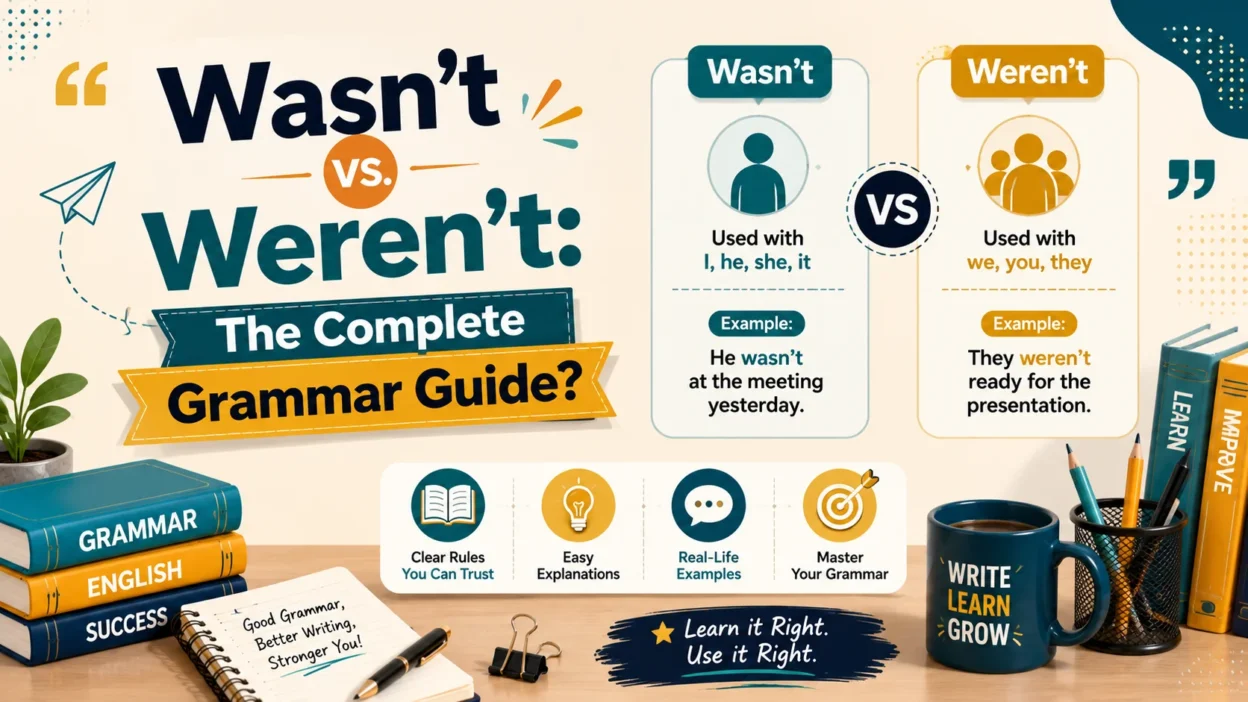
“Wasn’t” vs. “weren’t” becomes easier when you focus on the subject before the sound of the sentence, helping you make the right grammar choice every time. In everyday English, spoken English, and written English, correct subject-verb agreement, verb agreement, and the past tense of the verb “to be” determine whether to use “wasn’t” or “weren’t.” A singular subject takes wasn’t, while plural subjects take weren’t.
Every sentence, sentence pattern, sentence structure, and sentence formation follows a logical pattern based on agreement, meaning, and proper usage. In plain English and conversational English, the grammar rule stays the same unless the subjunctive mood is involved. In hypothetical statements, hypothetical situations, or a hypothetical context, expressions like “if I weren’t you” follow subjunctive usage instead of ordinary English grammar.
A good grammar guide, reference guide, or instructional guide serves as a valuable learning resource for language learning and grammar learning. It should include grammar concepts, grammar examples, real-life examples, practical examples, comparisons, tables, helpful tips, practical tips, examples, phrases, and question forms that explain language rules, language structure, English usage, and practical grammar.
Wasn’t vs. Weren’t at a Glance
If you only need a quick answer, here’s the simplest rule.
| Subject | Correct Form | Example |
| I | wasn’t | I wasn’t tired yesterday. |
| You | weren’t | You weren’t late. |
| He | wasn’t | He wasn’t at work. |
| She | wasn’t | She wasn’t ready. |
| It | wasn’t | It wasn’t broken. |
| We | weren’t | We weren’t hungry. |
| They | weren’t | They weren’t invited. |
| Singular noun | wasn’t | The dog wasn’t barking. |
| Plural noun | weren’t | The dogs weren’t barking. |
Quick rule:
- Use “wasn’t” with most singular subjects.
- Use “weren’t” with plural subjects and “you.”
- Use “weren’t” in many hypothetical or imaginary situations, even with “I.”
Examples
- I wasn’t feeling well.
- The movie wasn’t interesting.
- They weren’t ready to leave.
- You weren’t paying attention.
- If I weren’t so busy, I’d help you.
Grammar Tip: Learn the subject first. Once you know whether it’s singular, plural, or part of a hypothetical statement, choosing between wasn’t and weren’t becomes much easier.
What Do “Wasn’t” and “Weren’t” Mean?
Both “wasn’t” and “weren’t” are contractions.
- Wasn’t = was not
- Weren’t = were not
They express a negative state or condition in the past. Instead of saying someone or something was somewhere or was doing something, these contractions show that it was not or was not.
For example:
- She wasn’t at home.
- We weren’t ready.
- The weather wasn’t cold.
- The children weren’t asleep.
Because they’re contractions, they sound more natural in everyday English. Native speakers use them constantly in conversations, emails, and informal writing.
Why They Matter
The verb to be is one of the most common verbs in English. Every day, people describe locations, feelings, conditions, identities, and situations using this verb.
That means you’ll encounter “wasn’t” and “weren’t” in conversations like these:
- Yesterday wasn’t easy.
- They weren’t expecting visitors.
- My phone wasn’t working.
- We weren’t prepared for the meeting.
Mastering these forms improves both your speaking and writing because they appear in nearly every type of communication.
Wasn’t vs. Weren’t: The Key Difference
The biggest difference comes down to subject-verb agreement.
English verbs change depending on the subject. In the past tense of “to be,” there are only two forms:
| Subject Type | Positive | Negative |
| Singular | was | wasn’t |
| Plural | were | weren’t |
Let’s look at each group.
Singular Subjects Use Wasn’t
Use “wasn’t” with singular subjects such as
- I
- He
- She
- It
- One person
- One animal
- One object
Examples:
- I wasn’t nervous.
- He wasn’t listening.
- The laptop wasn’t charged.
- My sister wasn’t home.
- The restaurant wasn’t open.
Every subject above refers to one person, place, thing, or idea.
Plural Subjects Use Weren’t
Use “weren’t” with plural subjects.
Examples:
- We weren’t finished.
- They weren’t interested.
- My parents weren’t home.
- The books weren’t expensive.
- The lights weren’t on.
Each subject refers to more than one person or thing.
The Special Case of “You”
Many learners expect you to be patient when talking to one person.
That isn’t how English works.
Whether “you” refers to one person or many people, it always uses “were” in the past tense.
Correct:
- You weren’t late.
- You weren’t wrong.
- You weren’t at school yesterday.
Incorrect:
- You weren’t late.
This rule has remained part of standard English for centuries.
Subject-Verb Agreement Rules Explained
Subject-verb agreement simply means the verb matches the subject.
Although this sounds technical, it’s actually one of the easiest grammar rules once you recognize the subject.
First-Person Subjects
The first person refers to the speaker.
| Subject | Correct Form |
| I | wasn’t |
| We | weren’t |
Examples:
- I wasn’t expecting that answer.
- We weren’t ready for the exam.
- I wasn’t feeling my best yesterday.
- We weren’t sure which road to take.
Notice how the verb changes based on whether the speaker is alone or part of a group.
Second-Person Subjects
Second person refers to the listener.
The rule never changes.
| Subject | Correct Form |
| You | weren’t |
Examples:
- You weren’t at the party.
- You weren’t paying attention.
- You weren’t supposed to park there.
- You weren’t alone.
Whether speaking to one person or twenty people, “aren’t” is always correct.
Third-Person Singular Subjects
Third-person singular subjects represent one person, one place, one thing, or one idea.
Examples include:
- he
- she
- it
- my teacher
- the cat
- the company
Each use wasn’t.
Examples:
- He wasn’t interested.
- She wasn’t available.
- The cat wasn’t hungry.
- The company wasn’t profitable.
- The movie wasn’t very exciting.
Third-Person Plural Subjects
Plural subjects always pair with weren’t.
Examples include:
- they
- the students
- my friends
- the dogs
- the houses
Examples:
- They weren’t listening.
- The students weren’t ready.
- My friends weren’t surprised.
- The dogs weren’t barking.
- The houses weren’t occupied.
Indefinite Pronouns
Some indefinite pronouns confuse learners because they sound plural but are actually singular.
Singular indefinite pronouns include:
- everyone
- everybody
- someone
- somebody
- anyone
- nobody
- each
- every person
Use wasn’t with these words.
Examples:
- Everyone wasn’t invited. (This sentence is grammatically possible but may create ambiguity.)
- Nobody was hurt. (Usually rewritten for clarity.)
- Someone wasn’t telling the truth.
Often, writers choose different wording because double negatives or ambiguous subjects can confuse readers.
Compound Subjects
Compound subjects usually take “weren’t” because they refer to more than one person or thing.
Examples:
- Sarah and Tom weren’t home.
- The manager and assistant weren’t available.
- My brother and I weren’t ready.
However, if the compound subject refers to one combined idea, singular agreement may apply.
Example:
- Peanut butter and jelly wasn’t my favorite lunch.
Although this type of sentence appears occasionally, most compound subjects are plural.
When to Use Wasn’t
Whenever your subject is singular, wasn’t is usually the correct choice.
Think about one person, one object, one place, or one situation.
I wasn’t.
Examples:
- I wasn’t hungry after dinner.
- I wasn’t expecting your call.
- I wasn’t ready for the interview.
- I wasn’t worried until later.
Notice that ordinary past events use wasn’t, not weren’t.
He wasn’t.
Examples:
- He wasn’t feeling well.
- He wasn’t interested in sports.
- He wasn’t aware of the change.
- He wasn’t driving too fast.
She wasn’t.
Examples:
- She wasn’t nervous before the presentation.
- She wasn’t at work yesterday.
- She wasn’t ready to leave.
- She wasn’t upset.
It wasn’t.
Use “it wasn’t” when referring to weather, time, situations, objects, or animals.
Examples:
- It wasn’t raining.
- It wasn’t expensive.
- It wasn’t difficult.
- It wasn’t my fault.
Singular Nouns
Singular nouns also take wasn’t.
Examples:
- The teacher wasn’t late.
- The coffee wasn’t hot.
- The museum wasn’t open.
- The answer wasn’t correct.
- My computer wasn’t working.
Everyday Examples
Here are examples you’ll hear naturally.
At school
- The homework wasn’t difficult.
- The teacher wasn’t angry.
At work
- The meeting wasn’t long.
- My manager wasn’t available.
At home
- Dinner wasn’t ready.
- The television wasn’t on.
While traveling
- The flight wasn’t delayed.
- The hotel wasn’t crowded.
These examples show how often “wasn’t” appears in daily communication.
When to Use Weren’t
Use “weren’t” whenever the subject is plural or the subject is “you.”
The same rule applies whether you’re speaking casually, writing an email, or completing a grammar exercise.
You Weren’t
Remember that what you always took wasn’t in the simple past.
Examples:
- You weren’t listening carefully.
- You weren’t late after all.
- You weren’t the only one who noticed.
- You weren’t expected until noon.
This rule applies to both singular and plural you.
We Weren’t
Use “weren’t” when talking about yourself and others.
Examples:
- We weren’t finished yet.
- We weren’t prepared for the weather.
- We weren’t planning to stay long.
- We weren’t disappointed with the results.
They weren’t.
Use “weren’t” for groups of people, animals, or things.
Examples:
- They weren’t interested in the offer.
- They weren’t at the concert.
- They weren’t aware of the problem.
- They weren’t ready to begin.
Plural Nouns
Plural nouns always pair with weren’t.
Examples:
- The children weren’t sleepy.
- The players weren’t nervous.
- The stores weren’t open.
- The lights weren’t working.
- The flowers weren’t fresh.
Everyday Examples
At the office
- The employees weren’t informed.
- The computers weren’t connected.
At school
- The students weren’t noisy.
- The classrooms weren’t full.
During travel
- The flights weren’t delayed.
- The roads weren’t busy.
At home
- The dishes weren’t clean.
- The neighbors weren’t outside.
These examples reinforce the core rule: plural subjects require weren’t.
Wasn’t vs. Weren’t Comparison Table
The easiest way to remember “wasn’t” vs. “weren’t” is to match the verb with the subject. Keep this table handy whenever you write or proofread.
| Subject | Correct Form | Example |
| I | wasn’t | I wasn’t tired after work. |
| You (singular) | weren’t | You weren’t late today. |
| You (plural) | weren’t | You weren’t ready for the meeting. |
| He | wasn’t | He wasn’t at school. |
| She | wasn’t | She wasn’t interested. |
| It | wasn’t | It wasn’t easy. |
| We | weren’t | We weren’t expecting visitors. |
| They | weren’t | They weren’t available yesterday. |
| Singular noun | wasn’t | The car wasn’t clean. |
| Plural noun | weren’t | The cars weren’t clean. |
A Simple Memory Trick
Think about the subject before the verb.
- One person or one thing? Use wasn’t.
- More than one person or thing? Use weren’t.
- You? Always use weren’t.
This quick check prevents most grammar mistakes.
Wasn’t and Weren’t in Negative Sentences
Negative sentences tell us that something did not happen, did not exist, or was not true in the past.
The structure is simple.
| Sentence Type | Structure |
| Singular | Subject + wasn’t + complement |
| Plural | Subject + weren’t + complement |
Negative Sentences with Singular Subjects
Examples:
- I wasn’t busy yesterday.
- She wasn’t at the office.
- The movie wasn’t interesting.
- My phone wasn’t charged.
- The restaurant wasn’t open.
Each sentence describes one person, place, or thing.
Negative Sentences with Plural Subjects
Examples:
- We weren’t late.
- They weren’t prepared.
- The books weren’t expensive.
- The students weren’t noisy.
- My cousins weren’t home.
The same pattern works for every plural subject.
Expanding Negative Sentences
You can make your writing more descriptive by adding details.
Instead of:
- The hotel wasn’t good.
Write:
- The hotel wasn’t as comfortable as the reviews suggested.
Instead of:
- They weren’t happy.
Write:
- They weren’t happy because their flight was canceled.
These small additions create clearer, more engaging sentences.
Using Wasn’t and Weren’t in Questions
Questions follow the same grammar rules as statements. The only difference is the word order.
Yes-or-No Questions
Structure:
Was/Were + Subject + Complement?
Examples:
- Wasn’t he invited?
- Wasn’t the movie great?
- Weren’t they ready?
- Weren’t you at work yesterday?
Notice that the contraction appears naturally in conversational English.
Wh-Questions
Wh-questions begin with words such as who, what, when, where, why, and how.
Examples:
- Why wasn’t she at the meeting?
- Where wasn’t the package delivered?
- Why weren’t they informed?
- When weren’t you available?
These questions ask for specific information instead of a simple yes or no.
Question Tags
Question tags help confirm information.
Examples:
- She wasn’t angry, was she?
- He wasn’t late, was he?
- They weren’t upset, were they?
- We weren’t wrong, were we?
The tag uses the positive form because the main sentence is negative.
Short Answers
Short answers sound natural in conversation.
Examples:
Question: Wasn’t she at home?
Answer: Yes, she was.
Question: Weren’t they invited?
Answer: No, they weren’t.
Native speakers use these responses every day.
“Wasn’t” vs. “Weren’t” in the Subjunctive Mood
This is where many learners become confused.
Normally, I use wasn’t.
However, imaginary, hypothetical, or impossible situations often use “weren’t” instead.
This grammar pattern is called the subjunctive mood.
Why “If I Weren’t” Is Correct
Consider this sentence:
If I weren’t so busy, I’d join you.
The speaker is busy.
The sentence imagines a different reality.
Because the situation is hypothetical, English traditionally uses “were,” even with “I,” “he,” “she,” and “it.”
Hypothetical Situations
Examples:
- If I weren’t tired, I’d go running.
- If she weren’t afraid, she’d try skydiving.
- If he weren’t sick, he’d attend the meeting.
- If it weren’t raining, we’d have a picnic.
Each sentence imagines something that isn’t true.
Wishes
The subjunctive also appears after wish.
Examples:
- I wish I weren’t so nervous.
- She wishes she weren’t so busy.
- He wishes he weren’t working today.
These wishes describe unreal situations rather than past facts.
Formal vs. Informal English
In formal writing, grammar experts recommend using “weren’t” for hypothetical situations.
Example:
- If I weren’t you, I’d apologize.
In everyday conversation, many native speakers say the following:
- If I were not you…
Although common in informal speech, many style guides still consider If I weren’t the preferred standard.
Grammar Insight: When the sentence describes reality, use wasn’t. When it imagines another reality, weren’t is usually the better choice.
Wasn’t or Weren’t After “If”
The word “if” can introduce two very different ideas.
Understanding the difference solves one of the biggest grammar questions in English.
Real Past Situations
Use “wasn’t” or “weren’t” according to the subject.
Examples:
- If I wasn’t clear yesterday, I apologize.
- If she wasn’t home, she must have been working.
- If they weren’t ready, we should have waited.
These sentences discuss actual past events.
Unreal Situations
Now compare these examples.
- If I weren’t rich, I’d still be happy.
- If she weren’t so busy, she’d travel more.
- If he weren’t my brother, I’d never believe him.
These situations are imaginary.
That’s why “weren’t” appears even with singular subjects.
Comparing the Two
| Sentence | Meaning |
| If I were rude, I’m sorry. | Refers to a real past possibility. |
| If I weren’t rude, people would like me more. | Imagines a different reality. |
This distinction helps you choose the correct form every time.
Common Mistakes and How to Fix Them
Many learners repeat the same mistakes because they memorize words instead of grammar patterns.
Let’s fix the most common ones.
Mistake: Using Wasn’t with Plural Subjects
Incorrect:
- They weren’t ready.
- We weren’t hungry.
Correct:
- They weren’t ready.
- We weren’t hungry.
Mistake: Using “weren’t” with Singular Subjects
Incorrect:
- She wasn’t home.
- My phone wasn’t working.
Correct:
- She wasn’t home.
- My phone wasn’t working.
Mistake: Forgetting That “You” Uses Weren’t
Incorrect:
- You weren’t listening.
Correct:
- You weren’t listening.
This rule never changes.
Mistake: Confusing the Subjunctive
Many learners avoid If I weren’t, because it sounds unusual.
Remember this pattern.
Real event
- If I wasn’t helpful, I’m sorry.
Imaginary event
- If I weren’t so shy, I’d speak more often.
Knowing the difference makes your writing much more polished.
Wasn’t vs. Weren’t in American and British English
One common question is whether American English and British English follow different rules.
The answer is not really.
Both varieties follow the same grammar.
Standard Grammar
Both American and British English use the following:
- I wasn’t
- He wasn’t
- We weren’t
- They weren’t
The grammar stays consistent across both regions.
Informal Speech
In everyday conversation, you may hear the following:
- If I were you…
Although common in spoken English, especially in informal settings, grammar books generally recommend:
- If I were you…
The same applies to negative forms.
Preferred:
- If I weren’t you…
Less formal:
- If I were not you…
Should You Worry?
For school assignments, professional emails, business writing, and formal documents, use the traditional grammar rule.
For casual conversations, you’ll hear both versions from native speakers.
Everyday Examples by Situation
Learning grammar becomes much easier when you see it in realistic situations.
Conversations
Friend A: What prevented you from attending dinner?
Friend B: I wasn’t feeling good.
Friend A: Did Alex not arrive?
Friend B: He couldn’t get out of work early.
School
- The assignment wasn’t difficult.
- The students weren’t confused.
- Our teacher wasn’t absent yesterday.
- We weren’t finished before the bell.
Workplace
- The manager wasn’t available.
- The reports weren’t complete.
- We weren’t expecting another meeting.
- The presentation wasn’t ready.
Travel
- The airport wasn’t crowded.
- The flights weren’t delayed.
- The hotel wasn’t expensive.
- The tourists weren’t disappointed.
Family Life
- Mom wasn’t home yet.
- Dad wasn’t worried.
- The kids weren’t asleep.
- The pets weren’t hungry.
Real-life examples help these grammar rules become second nature.
Common Expressions Using Wasn’t and Weren’t
Some expressions appear so often that native speakers recognize them instantly.
Examples with wasn’t
- It wasn’t me.
- It wasn’t worth it.
- It wasn’t my fault.
- Life wasn’t easy.
- That wasn’t funny.
- She wasn’t kidding.
Examples with weren’t
- We weren’t ready.
- They weren’t serious.
- You weren’t supposed to do that.
- They weren’t expecting us.
- We weren’t sure.
- You weren’t wrong.
Learning complete expressions builds fluency faster than memorizing isolated rules.
Quick Grammar Tricks to Remember
If you forget the rules, use these shortcuts.
Remember the subject first.
Before choosing the verb, identify who or what you’re talking about.
Ask yourself:
- Is it one person?
- Is it several people?
- Is it you?
- Is it hypothetical?
Answering these questions usually gives you the correct form immediately.
The Three-Rule Shortcut
- Singular = wasn’t
- Plural = weren’t
- Hypothetical = weren’t
Most English sentences fit one of these three categories.
Proofreading Checklist
Before finishing your writing, check the following:
- Does the verb match the subject?
- Is the sentence talking about a real event?
- Is it an imaginary situation?
- Did you remember that you always took turns?
- Does the sentence sound natural when read aloud?
Professional writers often catch grammar mistakes by reading their work slowly instead of silently skimming it.
Remember: Grammar isn’t about memorizing hundreds of rules. It’s about recognizing patterns. Once you identify the subject and understand the situation, choosing between wasn’t and weren’t becomes almost automatic.
Conclusion
Understanding “wasn’t” vs. “weren’t” becomes much simpler once you focus on the subject and the meaning of the sentence. “Wasn’t” goes with singular subjects, while “weren’t” matches plural subjects and “you.” The main exception appears in the subjunctive mood, where phrases like “If I weren’t you” describe imaginary or hypothetical situations.
FAQs
Q1. What is the main difference between “wasn’t” and “weren’t”?
“Wasn’t” is used with most singular subjects, such as “I,” “he,” “she,” “it,” and singular nouns. “Weren’t” is used with plural subjects, “we,” “they,” and “you,” whether “you” refers to one person or several.
Q2. Why do we say “If I weren’t” instead of “If I wasn’t”?
The phrase “If I weren’t” uses the subjunctive mood, which expresses hypothetical, imaginary, or unreal situations. Although “If I wasn’t” appears in informal speech, “If I weren’t” is the standard choice in formal English.
Q3. Can “you weren’t” ever be correct?
No. In standard English grammar, you always take “were” in the past tense. The correct negative form is “you weren’t,” whether you are speaking to one person or a group.
Q4. How can I remember when to use “wasn’t” or “weren’t”?
A simple memory trick is to identify the subject first. If the subject is singular, use wasn’t. If the subject is plural or you, use weren’t. Then check whether the sentence is hypothetical, because those situations often require weren’t.
Q5. Weren’t “wasn’t” and “weren’t” used in both speaking and writing?
Yes. “Wasn’t” and “weren’t” are common in everyday conversations, emails, academic writing, business communication, and creative writing. Using the correct form makes your English sound more natural, accurate, and professional.