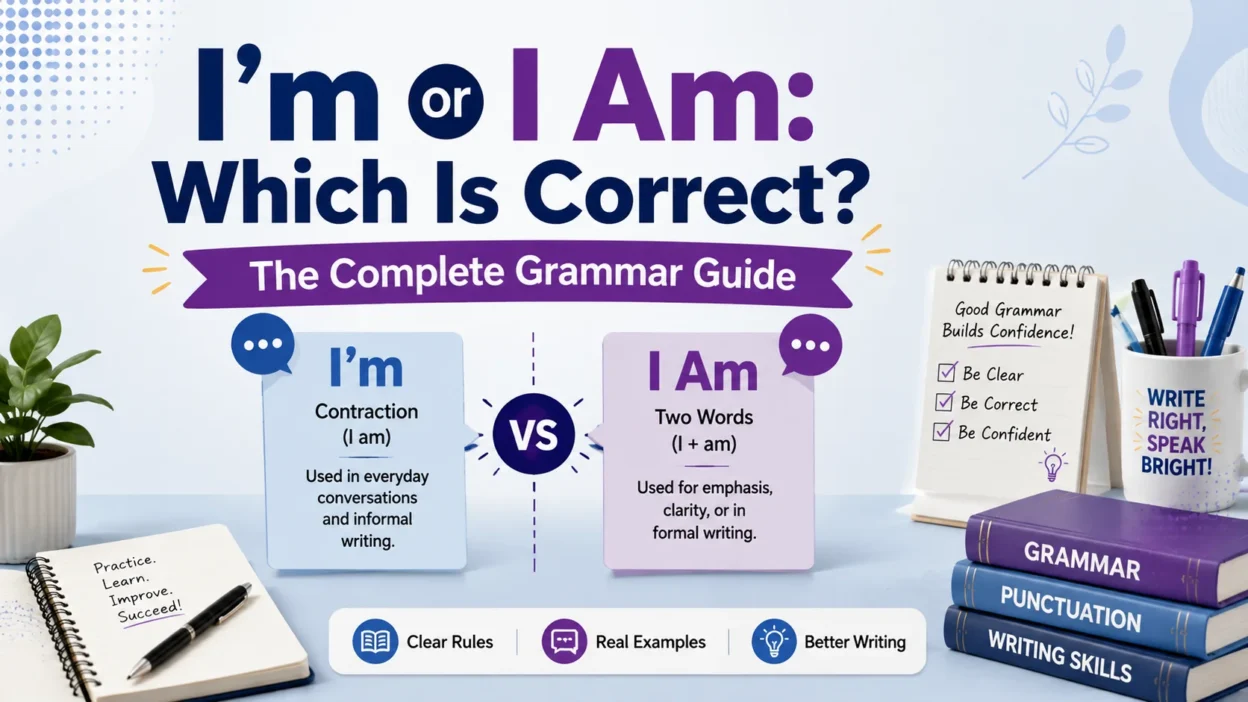
Choosing between I’m or I Am depends on the context, audience, purpose, tone, and level of formality. Both forms are grammatically correct, and understanding grammar, correct usage, word choice, and communication helps English learners, native speakers, and experienced English speakers write in clear English with confidence.
The main difference is style, not meaning. I’m is a contraction of the full form I am, making it ideal for casual speech, casual writing, and everyday conversations. I am fits formal writing, a job interview, or any setting where you want to emphasize your message. Learning sentence structure, expression, phrases, and contextual usage makes your English sound more natural.
A practical guide helps you learn, discover, and avoid common mistakes through regular practice. As your English proficiency, language skills, and communication skills improve, you will build confidence and choose the right form naturally for every situation.
Quick Answer
Both I’m and I am are grammatically correct.
- Use I’m in casual conversations and everyday writing.
- Use I am when you want a more formal or emphatic tone.
- The meaning stays exactly the same.
- Your choice depends on the situation and audience.
| Situation | Better Choice |
| Daily conversation | I’m |
| Text messages | I’m |
| Social media | I’m |
| Formal letters | I am |
| Academic writing | I am |
| Public speeches | I am |
For example:
- I’m excited to be here.
- I am excited to be here.
Both sentences express the same idea, but the second one sounds slightly more formal.
What Does “I’m” Mean?
“I’m” is simply the contracted form of “I am.” The apostrophe replaces the missing letter in am, making the sentence shorter and easier to say.
English speakers use contractions naturally because they make conversations flow better. That’s why you’ll hear I’m far more often than I am in everyday speech.
Definition of “I’m”
The word I’m combines:
- I (the first-person singular pronoun)
- am (the present tense of the verb to be)
Together, they describe a person’s identity, feelings, occupation, location, or current activity.
Examples include:
- I’m tired.
- I’m ready.
- I’m a student.
- I’m working today.
Each sentence is grammatically correct and sounds natural in conversation.
Why It’s a Contraction
Contractions shorten frequently used word combinations.
Instead of saying:
I am happy.
Most native speakers naturally say:
I’m happy.
This small change makes speech smoother without changing the meaning.
Other common contractions include:
| Full Form | Contraction |
| I am | I’m |
| You are | You’re |
| We are | We’re |
| They are | They’re |
| He is | He’s |
Contractions are accepted in standard English and appear in books, newspapers, websites, blogs, and everyday communication.
Common Examples in Everyday English
You’ll hear I’m almost everywhere.
Examples:
- I’m hungry.
- I’m almost home.
- I’m excited about the trip.
- I’m learning English.
Workplace examples:
- I’m available after lunch.
- I’m sending the report now.
- I’m checking the numbers.
Online examples:
- I’m watching a new movie.
- I’m planning my vacation.
- I’m grateful for your support.
These sentences sound friendly and conversational.
What Does “I Am” Mean?
I am is the complete, uncontracted form of the same phrase. Although it carries the same meaning as I’m, it creates a stronger or more formal tone.
Because every word is spoken separately, readers and listeners naturally pay more attention to it.
Definition of “I Am”
The phrase contains:
- I
- am
Together, they express:
- Identity
- Feelings
- Occupation
- Current actions
- Personal characteristics
Examples:
- I am a teacher.
- I am confident.
- I am studying biology.
- I am responsible for this project.
Why It Is the Full Form
Unlike contractions, the complete form doesn’t leave out any letters.
That makes it useful when clarity or emphasis matters.
Compare these two sentences:
- I’m responsible for the project.
- I am responsible for the project.
The second sentence naturally sounds more confident.
Common Examples in Different Situations
Formal writing:
- I am writing to apply for the position.
Public speaking:
- I am honored to accept this award.
Academic work:
- I am presenting the results of this study.
Important conversations:
- I am truly sorry for what happened.
Each example uses the complete form to create a more professional tone.
Is “I’m” Grammatically Correct?
Yes.
Many English learners think contractions are informal shortcuts that break grammar rules. That’s not true. I’m is completely correct and appears in standard English every day.
Major dictionaries and grammar guides recognize it as the accepted contraction of I am.
Standard English Grammar Rules
The apostrophe replaces the missing letter in am.
Correct:
- I’m ready.
- I’m your neighbor.
- I’m going home.
Incorrect:
- Im ready.
- I m ready.
- I’m am ready.
Using the apostrophe correctly is essential.
Why Native Speakers Prefer “I’m”
People naturally shorten common phrases while speaking.
Imagine hearing these sentences:
I’m glad you’re here.
Now compare that with:
I am glad you are here.
Both are correct, but the first sounds much more natural in everyday conversation.
That’s why contractions dominate spoken English.
Common Grammar Mistakes to Avoid
Watch out for these mistakes:
- Forgetting the apostrophe
- Writing Im
- Using I’m am
- Switching between formal and informal writing without a reason
Keeping your style consistent makes your writing easier to read.
Is “I Am” Grammatically Correct?
Absolutely.
I am is the original grammatical structure from which I’m is formed. Every English learner studies this version first because contractions develop from it.
Standard Grammar Rules
The verb to be changes depending on its subject.
| Subject | Verb |
| I | am |
| You | are |
| He | is |
| She | is |
| We | are |
| They | are |
Only I am is correct.
Why It Sounds More Formal
Writing every word in full naturally creates a more polished tone.
That’s why you’ll often find I am in:
- Academic papers
- Official documents
- Business correspondence
- Professional speeches
It helps readers take the message more seriously.
Situations Where the Full Form Works Best
Choose I am when writing:
- Cover letters
- Scholarship applications
- Formal complaints
- Official statements
- Professional biographies
- Academic essays
The complete form creates a stronger first impression.
I’m or I Am: What’s the Difference?
Although both forms mean exactly the same thing, they don’t always create the same impression.
| Feature | I’m | I Am |
| Meaning | Same | Same |
| Grammar | Correct | Correct |
| Formality | Informal | Formal |
| Conversation | Very common | Less common |
| Emphasis | Lower | Higher |
| Professional writing | Sometimes | Often preferred |
Meaning
There is no difference in meaning.
Examples:
- I’m ready.
- I am ready.
Both sentences communicate exactly the same idea.
Tone
Tone is where the real difference appears.
I’m sounds relaxed.
I am sounds stronger and more deliberate.
Formality
Use I’m for casual situations.
Choose I am when writing or speaking formally.
Pronunciation
Native speakers pronounce I’m as one smooth sound.
The full form places equal emphasis on both words.
That small pronunciation difference changes the overall tone.
Writing Style
Modern writing often encourages a conversational voice, especially online.
That’s why blogs, newsletters, and many business emails commonly use I’m.
Academic and highly formal documents often favor I am because it sounds more professional.
When to Use “I’m”
If you’re speaking casually or writing in a friendly tone, I’m is usually the better choice.
It reflects natural English and helps your sentences flow smoothly.
Everyday Conversations
Friends almost always use contractions.
Examples:
- I’m hungry.
- I’m tired.
- I’m coming.
- I’m almost finished.
Using the complete form in these situations may sound overly formal.
Text Messages and Online Chats
Fast conversations naturally include contractions.
Examples:
- I’m outside.
- I’m on my way.
- I’m free after work.
- I’m almost there.
These messages feel natural and effortless.
Emails to Friends and Coworkers
Friendly emails often include contractions because they sound approachable.
Example:
Hi Emma,
I’m sending the revised proposal this afternoon. I’m confident you’ll like the updates.
Thanks!
The email feels warm while remaining professional.
Social Media
Social media reflects spoken English.
Examples:
- I’m so excited for this weekend.
- I’m grateful for everyone’s support.
- I’m trying something new today.
The contraction keeps your writing conversational.
Blogs and Informal Articles
Most blog writers use contractions because readers enjoy content that feels personal.
Instead of writing:
I am going to explain…
Many writers prefer:
I’m going to explain…
The sentence immediately feels more engaging.
Personal Journals
Journal entries often capture thoughts exactly as they occur.
Examples:
- I’m feeling hopeful today.
- I’m nervous about tomorrow.
- I’m proud of my progress.
The writing sounds authentic and honest.
Creative Writing and Dialogue
Characters should sound like real people.
Instead of writing:
I am not leaving.
Most dialogue reads:
I’m not leaving.
Readers instantly recognize it as natural conversation.
When to Use “I Am”
Although contractions are common, there are situations where the complete form works better.
Choosing I am can add authority, confidence, and emphasis to your message.
Academic Writing
Many schools recommend avoiding contractions in formal assignments.
Example:
I am examining the relationship between language and culture.
The sentence sounds polished and appropriate for academic work.
Business Reports
Reports often require a professional tone.
Example:
I am responsible for preparing the quarterly financial summary.
The complete form creates a stronger impression.
Formal Emails and Letters
Many professional letters begin with the full form.
Example:
Dear Hiring Manager,
I am writing to express my interest in the open position.
This remains one of the most common openings in business writing.
Job Interviews
Both forms are acceptable during interviews.
However, candidates often use I am when highlighting important strengths.
Examples:
- I am passionate about helping customers.
- I am committed to continuous improvement.
- I am confident I can contribute to your organization.
The complete form adds emphasis without sounding unnatural.
Official Statements
Government officials, company leaders, and public speakers frequently choose I am because it sounds more authoritative.
Example:
I am committed to serving our community with integrity.
The statement feels stronger than the contracted version.
Public Speaking
Many speeches intentionally avoid contractions during memorable moments.
Examples:
- I am honored to stand before you today.
- I am grateful for your trust.
- I am proud of everything we have accomplished together.
Each sentence gains extra emphasis because every word receives equal attention.
Introducing Yourself
Formal introductions often sound smoother with the complete form.
Examples:
- I am David Wilson, your instructor.
- I am the project coordinator for today’s event.
- I am pleased to meet everyone.
These introductions create a confident first impression.
Adding Emphasis
Sometimes you simply want your words to carry more weight.
Compare these examples:
- I’m responsible for the decision.
- I am responsible for the decision.
The second sentence places stronger emphasis on personal responsibility and conviction.
When “I Am” Sounds More Natural Than “I’m”
Although I’m is more common in everyday English, there are moments when I am sounds stronger and more appropriate. The full form naturally adds emphasis because each word receives equal attention.
If you want listeners or readers to focus on what you’re saying, choosing I am can make your message more powerful.
Expressing Strong Emotions
People often switch to the full form when expressing sincere feelings.
Examples:
- I am deeply grateful for your support.
- I am truly sorry for what happened.
- I am incredibly proud of my team.
The emphasis makes the emotions feel more genuine.
Correcting Someone
When correcting a misunderstanding, the full form sounds clearer.
Examples:
- I am the manager, not my brother.
- I am talking about yesterday, not today.
- I am the person you contacted last week.
The stress naturally falls on am, making the correction more noticeable.
Making a Serious Promise
Important commitments often use the complete form.
Examples:
- I am committed to finishing this project.
- I am determined to improve.
- I am ready to accept the responsibility.
The full form reinforces confidence and determination.
Delivering a Speech
Public speakers frequently avoid contractions during key moments.
Examples:
- I am honored to receive this award.
- I am proud of what we have achieved together.
- I am thankful for every person in this room.
These sentences sound more memorable because they carry additional emphasis.
Stressing Identity or Belief
Sometimes the speaker wants to highlight identity or personal conviction.
Examples:
- I am an American citizen.
- I am your teacher.
- I am confident this decision is right.
The full form helps underline the message.
Why Native English Speakers Usually Say “I’m”
If you listen to native speakers, you’ll notice they almost always use I’m in casual conversation. That’s because contractions make English sound smoother and more natural.
Faster Natural Speech
English naturally favors shorter forms during conversation.
Instead of saying:
I am going home.
Most speakers say:
I’m going home.
The sentence becomes quicker without changing the meaning.
Rhythm and Fluency
Contractions improve the rhythm of spoken English.
Compare these examples:
- I’m excited.
- I’m ready.
- I’m leaving soon.
Each sentence flows naturally and feels conversational.
Everyday Conversation Habits
Native speakers learn contractions from childhood, so they rarely think about using them.
You’ll hear I’m in:
- Family conversations
- Phone calls
- Workplace discussions
- Podcasts
- Television shows
- YouTube videos
Using contractions helps speech sound relaxed rather than overly formal.
Can You Use “I’m” in Professional Writing?
Yes, in many situations.
Modern workplaces often encourage friendly communication. As a result, contractions appear in business emails, internal messages, newsletters, and customer communication.
The key is matching your tone to your audience.
Business Emails
Contractions help emails sound approachable.
Example:
I’m following up on yesterday’s meeting.
This sounds friendly while remaining professional.
Cover Letters
Traditional cover letters often begin with I am.
Example:
I am excited to apply for the Marketing Manager position.
However, many companies now accept a conversational style, especially in creative industries.
Workplace Communication
Internal communication usually includes contractions.
Examples:
- I’m reviewing your request.
- I’m available after lunch.
- I’m working on the presentation.
These sentences sound natural without appearing unprofessional.
Customer Support Messages
Many businesses intentionally use contractions because they create a warmer customer experience.
Example:
I’m happy to help resolve your issue today.
The message feels personal and welcoming.
Can You Use “I’m” in Academic Writing?
It depends on the style guide.
Some universities discourage contractions because they prefer a formal tone. Others allow them, especially in reflective essays or personal writing.
Always check your instructor’s requirements.
Essays
Many academic essays avoid contractions.
Preferred:
I am analyzing the historical evidence.
Instead of:
I’m analyzing the historical evidence.
Research Papers
Research papers usually maintain a formal style.
Many journals recommend avoiding contractions altogether.
College Assignments
Assignment expectations vary.
Some professors welcome conversational writing.
Others expect traditional academic English.
When unsure, choose the full form.
Style Guide Recommendations
Different style guides treat contractions differently.
| Writing Type | Recommended Choice |
| Academic essay | I am |
| Research paper | I am |
| Reflection paper | Either |
| Personal narrative | I’m |
| Blog article | I’m |
| Business email | Either |
Common Mistakes with “I’m” and “I Am”
Most learners understand the difference but still make small mistakes. Avoiding these common errors will make your writing look more polished.
Using the Wrong Tone
One of the biggest mistakes is choosing a style that doesn’t match the situation.
For example:
I’m writing to formally submit my legal declaration.
A better option:
I am writing to formally submit my legal declaration.
Formal writing usually benefits from the complete form.
Mixing Formal and Informal Styles
Keep your style consistent.
For example:
I am pleased to meet you. I’m extremely honored. I am looking forward to working together. I’m grateful.
Mixing styles isn’t technically wrong, but it may sound uneven.
Overusing the Full Form
Some English learners avoid contractions completely.
Instead of writing:
I am happy because I am learning English and I am practicing every day.
A more natural version is:
I’m happy because I’m learning English and I’m practicing every day.
The second sentence sounds much closer to everyday American English.
Incorrect Punctuation
Never forget the apostrophe.
Incorrect:
- Im happy.
- I m ready.
- I’m am ready.
Correct:
- I’m happy.
- I’m ready.
- I am ready.
Real-Life Examples of “I’m” and “I Am”
Seeing both forms in context makes the difference much easier to understand.
School
I am submitting my assignment today.
I’m studying for tomorrow’s exam.
I am grateful for your feedback.
Workplace
I’m joining the meeting in five minutes.
I am responsible for the project timeline.
I’m reviewing the report now.
Job Interview
I am passionate about customer service.
I am confident I can contribute to your team.
Customer Service
I’m happy to assist you today.
I’m checking your order now.
Healthcare
I’m feeling much better today.
I am allergic to peanuts.
Travel
I’m visiting New York next week.
I am traveling for business.
Presentations
I am pleased to present today’s findings.
I am excited to share our latest results.
I’m or I Am in American and British English
The grammar rule is identical in both American and British English.
The difference lies mainly in writing style and personal preference.
Similarities
Both varieties use:
- I’m
- I am
Both are grammatically correct.
Minor Style Differences
British English sometimes keeps a slightly more formal tone in official writing.
American English often encourages a conversational style, even in professional communication.
Which Form Is More Common?
In everyday speech, I’m is far more common in both American and British English.
Formal documents still favor I am.
Conclusion
Choosing between “I’m” and “I am” is simple once you understand the context, tone, and level of formality. Both forms are grammatically correct, but each works better in different situations. Use “I’m” for casual conversations and everyday writing, while “I am” is often the better choice for formal or professional communication. With regular practice, you’ll build confidence and know which form sounds most natural every time.
FAQs
Q1. Is I’m correct in everyday English?
Yes. I’m is the contracted form of I am and is perfectly correct for everyday conversations, text messages, blogs, and casual emails.
Q2. Should I use I am in formal writing?
Yes. I am is generally preferred in formal writing, academic papers, official letters, and professional situations because it sounds more formal and emphasizes the statement.
Q3. Is there any difference in meaning between I’m and I am?
No. Both have the same meaning. The only difference is the tone, style, and level of formality.
Q4. Can I use I’m in job interviews?
Yes. You can use I’m naturally during a job interview, although I am may sound stronger when you want to emphasize important qualifications or achievements.
Q5. How do I choose between I’m and I am?
Think about your audience, purpose, and setting. Choose I’m for informal communication and I am when writing or speaking in a more formal or professional context.