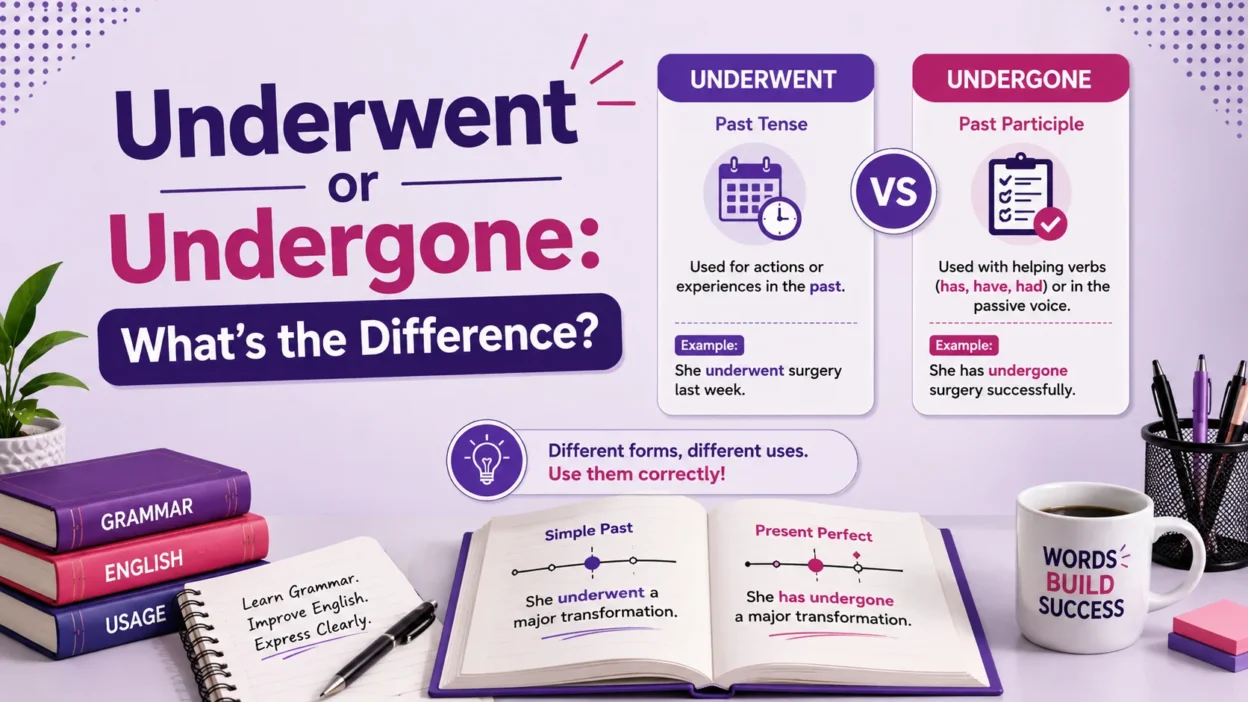
“Underwent” or “undergone” becomes easy once you understand the correct verb form, verb tense, and basic grammar rule. Underwent is the simple past tense, while Undergone is the past participle used with helping verbs like has, have, had, and been. Learning English grammar, verb usage, grammatical correctness, and the correct verb form helps English learners, ESL learners, students, native speakers, and professional writers improve writing, accuracy, clarity, and confidence.
Good sentence structure, careful word choice, and the correct usage remove confusion and prevent common mistakes. A simple comparison, comparison tables, real examples, practical examples, and an easy grammar guide make the difference between these forms easier to understand. This approach improves understanding, grammar accuracy, communication, and helps you write correctly in academic papers, business reports, medical documents, professional emails, and news articles.
For example, you write underwent surgery for a completed past action, but has undergone surgery when using the present perfect. The same rule applies to training, medical procedures, major life changes, and other significant events. Although both words share the same meaning, they are not interchangeable. Once you recognize the pattern and practice it in everyday conversations, choosing the right form becomes much easier.
Underwent or Undergone: The Quick Answer
If you’re looking for the short version, here it is.
- Use underwent for a completed action in the simple past tense.
- Use undergone only with a helping verb such as has, have, had, or will have.
The One-Sentence Rule
Underwent stands alone as the main verb, while undergone always follows a helping verb.
Quick Comparison Table
| Word | Verb Form | Helping Verb Needed? | Example |
| Undergo | Base form | No | Employees undergo annual training. |
| Underwent | Simple past | No | The patient underwent surgery yesterday. |
| Undergone | Past participle | Yes | The patient has undergone surgery. |
Everyday Examples
| Correct Sentence | Explanation |
| She underwent knee surgery last month. | Simple past tense |
| She has undergone knee surgery. | Present perfect tense |
| The building underwent repairs after the storm. | Completed action |
| The bridge had undergone inspection before opening. | Past perfect tense |
| The company has undergone major changes. | Present perfect tense |
Remember: If your sentence contains has, have, had, or will have, you’ll almost always need undergone, not underwent.
Why People Confuse Underwent or Undergone
The confusion comes from the fact that both words belong to the same verb and describe the same action. The only difference is grammar.
English contains many irregular verbs, and undergo is one of them. Unlike regular verbs that simply add -ed, irregular verbs change completely depending on the tense.
Consider these examples.
| Base Verb | Past Tense | Past Participle |
| Go | Went | Gone |
| Write | Wrote | Written |
| Break | Broke | Broken |
| Undergo | Underwent | Undergone |
Once you recognize this pattern, choosing between underwent or undergone becomes much easier.
Same Verb, Different Forms
Both words describe experiencing something, such as surgery, training, testing, or major changes.
For example:
- The hospital underwent renovations last year.
- The hospital has undergone extensive renovations.
The event is the same. Only the verb tense changes.
Common Grammar Mistakes
Many writers accidentally replace one form with the other.
Incorrect:
- She has underwent surgery.
- They undergone training.
- The company has underwent restructuring.
Correct:
- She has undergone surgery.
- They have undergone training.
- The company has undergone restructuring.
These mistakes are common because both words are spelled correctly. The issue is grammatical, not lexical.
Why Grammar Checkers Sometimes Miss the Error
Many spelling tools recognize both underwent and undergone as valid English words. As a result, they may not flag the mistake if the sentence structure is incorrect.
That’s why understanding verb forms is more reliable than depending on automated grammar software.
Understanding the Verb “Undergo”
Before learning when to use underwent or undergone, it’s helpful to understand the original verb.
What Does Undergo Mean?
The verb undergo means to experience, to endure, to receive, or to go through something, especially something significant.
People commonly undergo:
- Surgery
- Medical treatment
- Physical therapy
- Testing
- Training
- Evaluation
- Inspection
- Rehabilitation
Organizations and objects can also undergo change.
Examples:
- The company undergoes annual financial audits.
- Students undergo practical examinations.
- The bridge undergoes routine inspections.
Is Undergo a Regular or Irregular Verb?
Undergo is an irregular verb, which means it doesn’t follow the normal -ed pattern.
Here are its forms.
| Verb Form | Word |
| Base Form | Undergo |
| Third Person Singular | Undergoes |
| Present Participle | Undergoing |
| Simple Past | Underwent |
| Past Participle | Undergone |
Because the forms are irregular, memorizing them is the easiest way to avoid mistakes.
Complete Verb Forms Table
| Tense | Example |
| Present Simple | They undergo annual training. |
| Present Continuous | They are undergoing training. |
| Simple Past | They underwent training last week. |
| Present Perfect | They have undergone training. |
| Past Perfect | They had undergone training before promotion. |
| Future Perfect | They will have undergone training by June. |
Common Situations Where Undergo Is Used
The verb appears frequently in formal and professional writing.
| Context | Example |
| Medical | Undergo surgery |
| Healthcare | Undergo treatment |
| Business | Undergo restructuring |
| Engineering | Undergo testing |
| Education | Undergo assessment |
| Construction | Undergo renovation |
| Manufacturing | Undergo quality inspection |
| Science | Undergo chemical changes |
Although undergo sounds formal, it appears regularly in newspapers, research papers, medical reports, and corporate communication.
When to Use “Underwent”
If you’re deciding between underwent or undergone, choose underwent whenever the action happened at a definite time in the past.
What Does Underwent Mean?
Underwent is the simple past tense of undergo. It describes an action that started and finished in the past.
Examples:
- She underwent surgery last Tuesday.
- The school underwent renovations during the summer.
- Our office underwent a complete redesign.
Each action has already been completed.
Grammar Rule
Use underwent without a helping verb.
Sentence Formula
Subject + Underwent + Object
Examples:
- The athlete underwent physical therapy.
- The building underwent inspection.
- The software underwent security testing.
- The patient underwent emergency treatment.
Examples in the Simple Past Tense
Medical Examples
- My grandfather underwent heart surgery last year.
- The patient underwent chemotherapy for six months.
- She underwent routine medical testing before the procedure.
Business Examples
- The company underwent a major restructuring.
- Our department underwent organizational changes.
Education Examples
- Students underwent practical assessments.
- Teachers underwent professional development training.
Construction Examples
- The airport underwent expansion in 2024.
- The bridge underwent structural repairs after the earthquake.
Technology Examples
- The application underwent extensive security testing.
- The software underwent several performance improvements.
How to Recognize the Correct Pattern
A quick way to decide is to look for a completed time reference.
Words and phrases such as these usually signal the simple past tense:
- Yesterday
- Last week
- Last year
- In 2024
- During the summer
- Earlier this month
- Before graduation
Examples:
- The patient underwent surgery last Friday.
- The company underwent restructuring in 2024.
- The building underwent renovation during the winter.
When the action clearly happened and ended in the past, underwent is the correct choice.
Common Errors with Underwent
Incorrect:
- She has underwent surgery.
- They have underwent training.
- The bridge had underwent inspection.
Correct:
- She has undergone surgery.
- They have undergone training.
- The bridge had undergone inspection.
Grammar Tip: Never use underwent after has, have, had, or will have. Those helping verbs always require the past participle undergone.
When to Use “Undergone”
If underwent describes a completed action in the simple past, undergone belongs to a different part of English grammar. It is the past participle of undergo, so it cannot stand alone. Instead, it must be paired with a helping verb such as has, have, had, will have, or having.
This is the rule that separates correct English from one of the most common grammar mistakes.
What Does Undergone Mean?
Undergone means experienced, gone through, or been subjected to something. The meaning stays the same as undergo and underwent, but the sentence structure changes because you’re using a perfect tense.
Examples:
- She has undergone surgery.
- The company has undergone major changes.
- They had undergone extensive training before starting work.
- By next month, the bridge will have undergone final inspections.
Why It Always Needs a Helping Verb
A past participle cannot function as the main verb by itself.
For example:
She undergone surgery.
She has undergone surgery.
The building undergone renovation.
The building had undergone renovation.
The helping verb creates a complete verb phrase, making the sentence grammatically correct.
Common Helping Verbs
You’ll most often see undergone with these auxiliary verbs.
| Helping Verb | Example |
| Has | She has undergone surgery. |
| Have | They have undergone training. |
| Had | The bridge had undergone repairs. |
| Will have | The project will have undergone review. |
| Having | Having undergone treatment, he returned home. |
Sentence Formula
| Tense | Formula | Example |
| Present Perfect | Subject + has/have + undergone + object | The patient has undergone surgery. |
| Past Perfect | Subject + had + undergone + object | The patient had undergone treatment. |
| Future Perfect | Subject + will have + undergone + object | The patient will have undergone therapy. |
Examples in Perfect Tenses
Present Perfect
- She has undergone knee surgery.
- Our company has undergone rapid growth.
- The software has undergone multiple updates.
Past Perfect
- The building had undergone inspection before reopening.
- Students had undergone training before the competition.
- The patient had undergone several tests before the diagnosis.
Future Perfect
- By December, the bridge will have undergone safety testing.
- The organization will have undergone a complete audit.
- The research project will have undergone peer review.
Common Errors with Undergone
Incorrect:
- She undergone surgery yesterday.
- They undergone testing.
- The company undergone restructuring.
Correct:
- She underwent surgery yesterday.
- They underwent testing.
- The company underwent restructuring.
Notice the pattern. If there’s no helping verb, you should almost always choose underwent instead.
Underwent or Undergone: Side-by-Side Comparison
The easiest way to understand these words is to compare them directly.
Grammar Differences
| Feature | Underwent | Undergone |
| Verb Form | Simple Past | Past Participle |
| Can Stand Alone? | Yes | No |
| Requires Helping Verb? | No | Yes |
| Used in Perfect Tenses? | No | Yes |
| Indicates Completed Past Action? | Yes | Yes |
Sentence Structure Comparison
| Correct with Underwent | Correct with Undergone |
| She underwent surgery. | She has undergone surgery. |
| The company underwent restructuring. | The company has undergone restructuring. |
| The bridge underwent repairs. | The bridge had undergone repairs. |
Tense Comparison Table
| Tense | Correct Example |
| Present | Employees undergo training every year. |
| Past | Employees underwent training last week. |
| Present Perfect | Employees have undergone training. |
| Past Perfect | Employees had undergone training. |
| Future Perfect | Employees will have undergone training. |
Quick Memory Trick
Think about the word gone inside undergone.
Words ending in gone, such as gone itself, usually appear with helping verbs.
- She has gone home.
- She has undergone surgery.
If you see has, have, or had, your brain should automatically think undergone.
Verb Tenses Explained with Undergo
Learning every form of undergo makes choosing the correct word much easier.
Base Form: Undergo
Use the base form for the present tense, infinitives, and modal verbs.
Examples:
- Employees undergo annual training.
- You should undergo regular health screenings.
- Doctors recommend that patients undergo testing.
Present Simple Examples
- The laboratory undergoes inspection every month.
- Students undergo assessments twice a year.
- Every employee undergoes orientation.
Past Simple: Underwent
The simple past describes an action completed in the past.
Examples:
- She underwent surgery in March.
- The company underwent major restructuring.
- The bridge underwent repairs after the storm.
Present Perfect: Has/Have Undergone
Use the present perfect when a past event connects to the present.
Examples:
- She has undergone surgery and is recovering well.
- The company has undergone significant changes.
- The software has undergone several improvements.
Past Perfect: Had Undergone
The past perfect shows that one action happened before another past event.
Examples:
- The patient had undergone testing before receiving the diagnosis.
- The building had undergone inspection before reopening.
- The engineers had undergone certification before beginning the project.
Future Perfect: Will Have Undergone
Use the future perfect for actions that will be completed before a future point.
Examples:
- By next year, the airport will have undergone expansion.
- The students will have undergone practical training before graduation.
- The software will have undergone extensive testing before release.
Underwent or Undergone in Real-Life Contexts
These words appear most often in professional and formal writing.
Medical Writing
Medical professionals frequently describe treatments, surgeries, examinations, and procedures using undergo.
Examples:
- The patient underwent heart surgery yesterday.
- The patient has undergone successful treatment.
- She had undergone chemotherapy before the transplant.
Mini Case Study
A patient visits a hospital with severe chest pain.
Correct timeline:
- The patient underwent emergency surgery yesterday.
- The patient has undergone successful surgery and is recovering.
- By next month, the patient will have undergone rehabilitation.
Each sentence uses a different tense while following the same grammar rule.
Academic Writing
Universities and researchers often use undergo when discussing experiments and evaluations.
Examples:
- Participants underwent psychological testing.
- The research has undergone peer review.
- The manuscript had undergone several revisions.
Business Reports
Companies often undergo organizational changes.
Examples:
- The company underwent restructuring in 2024.
- Our organization has undergone digital transformation.
- The department had undergone internal audits before certification.
Construction and Engineering
Examples:
- The bridge underwent structural testing.
- The highway has undergone resurfacing.
- The building had undergone safety inspections before opening.
Legal and Government Documents
Government agencies often use this verb in official reports.
Examples:
- The proposal underwent legal review.
- The legislation has undergone multiple revisions.
- The documents had undergone verification before approval.
News Headlines
Journalists frequently choose this verb because it sounds concise and professional.
Examples:
- Airport Underwent Major Expansion
- Historic Building Has Undergone Restoration
- School Underwent Emergency Repairs
Active Voice vs. Passive Voice
Both verb forms work in active and passive sentences, but active voice usually sounds clearer and more engaging.
Active Voice Examples
- Doctors performed the surgery after the patient underwent testing.
- Engineers inspected the bridge after it underwent repairs.
- The company launched new products after it underwent restructuring.
Passive Voice Examples
- Surgery was performed after the patient had undergone testing.
- The bridge was reopened after repairs had been completed.
- The report was published after it had undergone review.
Which Sounds More Natural?
In most situations, active voice is easier to read because it clearly identifies who performed the action.
Compare these examples.
Passive:
The report was approved after it had undergone review.
Active:
The committee approved the report after it had undergone review.
The second sentence feels more direct and informative.
Common Grammar Mistakes You Should Avoid
Even experienced writers occasionally confuse these forms.
Using Underwent After Has, Have, or Had
Incorrect:
- She has underwent surgery.
Correct:
- She has undergone surgery.
Using Undergone Without a Helping Verb
Incorrect:
- The company undergone restructuring.
Correct:
- The company underwent restructuring.
Mixing Past Tense with Past Participle
Incorrect:
- They had underwent training.
Correct:
- They had undergone training.
Forgetting the Auxiliary Verb
Incorrect:
- The bridge undergone repairs.
Correct:
- The bridge has undergone repairs.
Grammar Quote: The easiest way to master irregular verbs is to learn their patterns, not memorize isolated sentences.
Underwent or Undergone in Professional Writing
Using the correct verb form builds credibility in professional documents.
Resume Examples
Correct:
- Underwent leadership training during management development.
Better:
- Successfully underwent advanced leadership training.
Medical Reports
Correct:
- The patient has undergone successful knee replacement surgery.
Academic Papers
Correct:
- The data had undergone statistical analysis before publication.
Business Emails
Correct:
- Our system has undergone scheduled maintenance.
Formal Documents
Correct:
- The proposal has undergone legal review and final approval.
Common Collocations with Undergo
Certain nouns naturally pair with undergo.
| Common Collocation | Example |
| Undergo surgery | She underwent surgery. |
| Undergo treatment | He has undergone treatment. |
| Undergo testing | The product underwent testing. |
| Undergo inspection | The bridge underwent inspection. |
| Undergo training | Employees have undergone training. |
| Undergo review | The report has undergone review. |
| Undergo renovation | The building underwent renovation. |
| Undergo transformation | The company has undergone transformation. |
Synonyms of Undergo (By Context)
Different situations call for different alternatives.
| Synonym | Best Used For |
| Experience | General events |
| Go through | Everyday conversation |
| Endure | Difficult situations |
| Face | Challenges |
| Receive | Medical treatment |
| Sustain | Damage or injury |
| Encounter | Situations or problems |
Comparison Table
| Original Sentence | Alternative |
| She underwent surgery. | She received surgery. |
| The company underwent restructuring. | The company experienced restructuring. |
| The bridge underwent repairs. | The bridge received repairs. |
While these alternatives work in some contexts, undergo remains the most precise choice in formal and technical writing.
Conclusion
Choosing between Underwent and Undergone becomes much simpler once you understand the grammar rule behind each form. Use underwent for a completed action in the simple past tense, and use undergone only with helping verbs such as has, have, or had. Remembering this one rule will improve your grammar, strengthen your writing, and help you communicate with greater accuracy in academic, professional, and everyday situations.
FAQs
Q1. What is the difference between underwent and undergone?
Underwent is the simple past tense of undergo, while undergone is the past participle. Use underwent alone and use undergone with helping verbs like has, have, or had.
Q2. Is “She undergone surgery” grammatically correct?
No. The correct sentence is “She has undergone surgery.” If there is no helping verb, use underwent, as in “She underwent surgery.”
Q3. Can underwent and undergone be used interchangeably?
No. Although they come from the same verb, they have different grammatical roles and cannot be used interchangeably.
Q4. How can I remember when to use undergone?
A simple trick is to look for a helping verb. If your sentence includes has, have, had, or will have, the correct form is usually undergone.
Q5. Where are underwent and undergone commonly used?
These verb forms often appear in medical reports, academic papers, business reports, professional emails, news articles, and other forms of formal writing.