“A Majority Of” vs. “The Majority Of” improves English writing by making your grammar, clarity, and communication more accurate. Many English learners, students, and writers confuse these phrases because they look similar. The main difference depends on context, specificity, meaning, and choosing the correct article, indefinite article, or definite article. A good grammar guide with examples, real examples, and practical examples makes the correct usage easier to understand.
Strong academic writing, professional writing, and everyday writing rely on proper usage, correct usage, sentence structure, context clues, and semantic meaning. Whether you’re writing an essay, business report, research paper, or email, using the right phrase improves message clarity, writing skills, comprehension, English proficiency, and confidence. Reviewing studies, practical advice, and every practical example also helps reduce confusion and avoid common mistakes.
Think of grammar as a useful tool for every writing job. Knowing when to refer, specify, or describe a general group, specific group, or known group makes your statements clearer. Even simple topics like people, class, online exams, or ice cream show how these expressions work. With regular writing practice, your skills improve, your writing becomes more precise, and your readers can easily receive your message.
Quick Answer: A Majority Of vs The Majority Of
Here’s the simplest way to remember the difference.
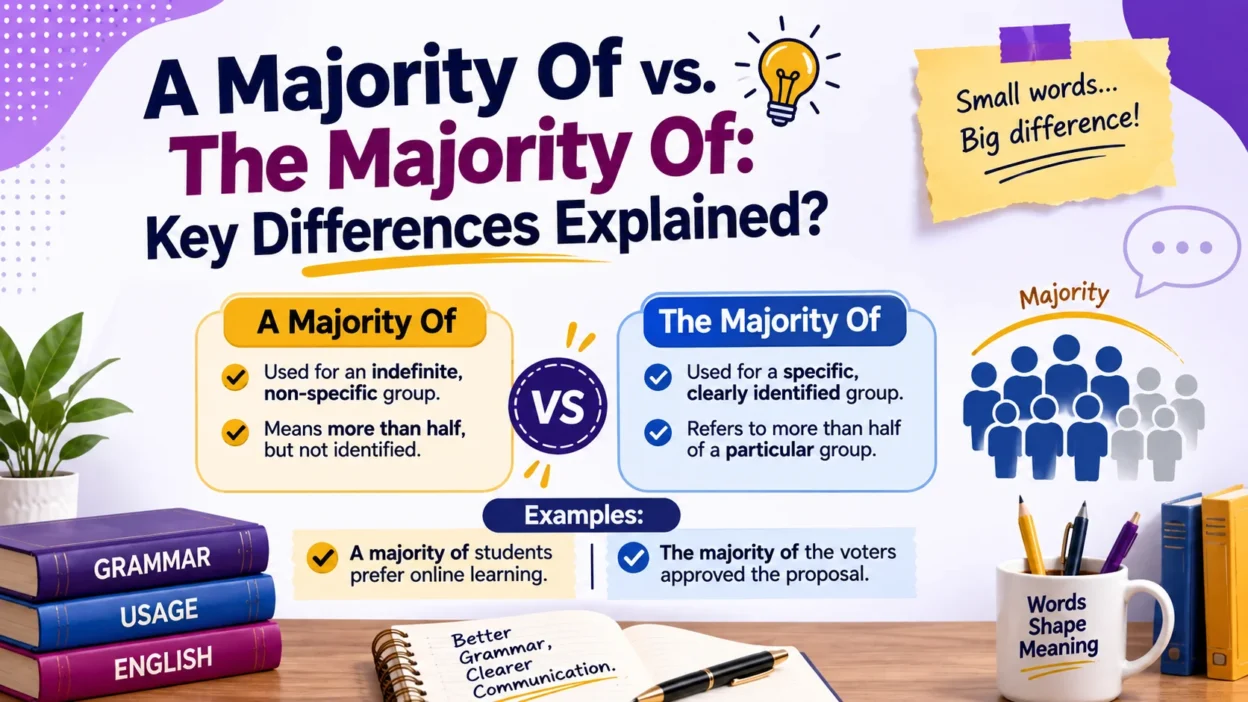
| Phrase | Best Use | Example |
| A majority of | Refers to any majority or emphasizes quantity | A majority of voters supported the proposal. |
| The majority of | Refers to a specific group already identified | The majority of the students passed the exam. |
The simple rule
- Use a majority of when introducing the idea that more than half of a group meets a condition.
- Use the majority of when referring to a particular group that readers or listeners already know.
Although native speakers often use both interchangeably, choosing the right one makes your writing clearer and more precise.
What Does “A Majority Of” Mean?
The phrase “a majority of” refers to more than 50% of a group without emphasizing a particular or previously identified group.
Think of it as introducing a majority rather than pointing to one that’s already known.
Definition and grammatical meaning
The article “a” is an indefinite article, meaning it refers to something in a general sense.
When paired with majority, it simply means:
More than half of a group.
The exact percentage doesn’t matter as long as it exceeds 50%.
For example:
- A majority of employees work remotely.
- A majority of respondents preferred online shopping.
- A majority of voters approved the measure.
In each sentence, the focus is on the numerical majority rather than a previously mentioned group.
Why the indefinite article matters
The word “a” tells readers you’re introducing the concept of a majority instead of identifying one already discussed.
Compare these sentences:
- A majority of Americans own smartphones.
- The majority of the Americans surveyed own smartphones.
The first sentence makes a broad statement.
The second refers to one specific group of Americans.
That small article changes the level of specificity.
Common sentence patterns
You’ll frequently see a majority of in these structures:
- A majority of + plural noun
- A majority of + people
- A majority of + respondents
- A majority of + voters
- A majority of + employees
Examples:
- A majority of teachers support smaller class sizes.
- A majority of participants completed the survey.
- A majority of customers renewed their memberships.
Real-life examples
Academic writing:
A majority of participants reported improved productivity after the policy change.
Business report:
A majority of customers rated the service as excellent.
Government report:
A majority of eligible voters cast ballots before Election Day.
News article:
A majority of lawmakers voted in favor of the bill.
Notice how every example emphasizes the percentage, not a previously identified group.
What Does “The Majority Of” Mean?
While a majority of introduces any majority, the majority of points to one particular majority.
The definite article “the” identifies a group that’s already known from context.
Definition and grammatical meaning
The majority of means:
Most members of a specific group.
The reader already knows which group you’re discussing.
Examples:
- The majority of the committee agreed.
- The majority of my coworkers work remotely.
- The majority of these books belong to the library.
Each sentence refers to a clearly identified collection.
Why the definite article changes the meaning
The word “the” acts like a spotlight.
Instead of talking about any majority, it points directly to one already established.
Compare:
- A majority of students passed.
- The majority of the students in Mr. Smith’s class passed.
The second sentence narrows the focus considerably.
Common sentence patterns
You’ll often find these structures:
- The majority of the students
- The majority of those surveyed
- The majority of our customers
- The majority of these cases
- The majority of employees in the department
Real-life examples
Education:
The majority of the students enrolled in Biology passed the final exam.
Business:
The majority of our clients renewed their contracts.
Healthcare:
The majority of patients recovered within two weeks.
Sports:
The majority of the team’s victories came at home.
Each sentence identifies a particular group instead of speaking generally.
A Majority Of vs The Majority Of: The Key Difference
Although both phrases describe more than half, they differ in one important way.
| Feature | A Majority Of | The Majority Of |
| Article | Indefinite | Definite |
| Meaning | Any majority | A specific majority |
| Focus | Quantity | Identified group |
| Formality | Often formal | Common in all styles |
| Common in research | Yes | Yes |
| Common in conversation | Sometimes | Very common |
Comparing meaning
Think about these examples.
A majority of applicants had previous experience.
The sentence introduces a numerical fact.
Now compare it with:
The majority of the applicants interviewed had previous experience.
Now you’re discussing a particular set of applicants.
Comparing context
Context often determines which phrase sounds natural.
Suppose you’re writing about election results.
Better:
A majority of voters supported the proposal.
Suppose you’ve already discussed one district.
Better:
The majority of the voters in District 8 supported the proposal.
Comparing tone
Although both phrases appear in formal writing, they create slightly different tones.
A majority of
- Sounds analytical
- Fits statistics
- Emphasizes numerical findings
- Common in research
The majority of
- Sounds conversational
- Fits everyday English
- References known groups
- Common in journalism
Side-by-side examples
| A Majority Of | The Majority Of |
| A majority of adults drink coffee. | The majority of the adults attending the conference drank coffee. |
| A majority of shoppers prefer online stores. | The majority of the shoppers we interviewed preferred online stores. |
| A majority of employees support flexible schedules. | The majority of the employees in our office support flexible schedules. |
When to Use “A Majority Of”
Choosing a majority of makes the most sense when your goal is to highlight numbers rather than identify a particular group.
Statistical reports and surveys
Researchers frequently use this phrase because it focuses on measurable results.
Examples:
- A majority of respondents preferred Option B.
- A majority of consumers shop online weekly.
- A majority of households own multiple devices.
This wording sounds objective and data-driven.
Academic and research writing
Universities, research organizations, and scientific journals often use a majority of when presenting findings.
Example:
A majority of participants demonstrated improved recall after six weeks of practice.
This style keeps the focus on evidence instead of individual groups.
Business reports
Companies also rely on this phrase to summarize survey data and market research.
Examples include:
- A majority of customers recommend our services.
- A majority of investors expect higher earnings.
- A majority of employees reported improved morale.
Because the emphasis is numerical, a majority of works naturally.
Government and legal documents
Legislation and official reports often describe voting outcomes using this phrase.
Examples:
- A majority of members approved the amendment.
- A majority of registered voters participated.
- A majority of shareholders supported the proposal.
Legal writing values precision, making this construction especially common.
Quick Tip: If you’re discussing statistics, percentages, polls, or research findings, “a majority of” is often the better choice because it emphasizes measurable data.
When to Use “The Majority Of”
Unlike a majority of, the majority of refers to a group that’s already clear from the surrounding context.
Everyday English
In daily conversation, people naturally use the majority of because they’re usually talking about a specific group everyone already understands.
Examples:
- The majority of my neighbors work downtown.
- The majority of our friends arrived early.
- The majority of the guests stayed until midnight.
This phrasing feels natural because the speaker has already identified the group.
Journalism and news writing
News articles frequently describe known groups rather than general populations.
Examples:
- The majority of the city council voted in favor of the proposal.
- The majority of residents supported the new recycling program.
- The majority of passengers escaped without injuries.
Readers immediately know which group the article discusses.
General statements about groups
When your audience already understands the context, the majority of creates smoother, more natural sentences.
Examples:
- The majority of these products are made locally.
- The majority of the documents require signatures.
- The majority of those interviewed expressed similar opinions.
Instead of introducing a new majority, you’re pointing to one that’s already defined.
Professional communication
Business emails, reports, and presentations often use the majority of when referring to internal teams or known departments.
Examples:
- The majority of our staff completed the training.
- The majority of the sales team exceeded their targets.
- The majority of the project budget has already been approved.
This wording avoids unnecessary repetition and keeps the message concise.
Grammar Rules for “Majority Of”
Understanding the grammar behind majority helps you avoid one of the most common writing mistakes: incorrect verb agreement.
Is “majority” singular or plural?
The noun majority is grammatically singular, but the verb you choose often depends on what follows it.
Consider these examples:
- The majority of the cake is gone.
- The majority of the students are present.
In the first sentence, cake is singular, so the verb is is.
In the second sentence, students is plural, so the verb becomes are.
Subject-verb agreement rules
Use this quick guide.
| Subject | Correct Verb |
| The majority of the class | is |
| The majority of students | are |
| A majority of voters | are |
| A majority of the population | is |
| The majority of employees | are |
A helpful rule is to look at the noun after of rather than focusing only on majority.
Collective noun considerations
Sometimes majority refers to a collective unit.
For example:
- The majority of the committee is united. (acting as one group)
- The majority of committee members are divided. (individual members)
The surrounding context determines which verb sounds most natural.
American vs British English differences
American English generally follows notional agreement, meaning the verb often matches the noun after of.
Examples:
- The majority of employees are satisfied.
- The majority of voters are undecided.
British English follows similar patterns but occasionally treats collective nouns differently in formal writing.
In most modern American writing, matching the verb to the noun after of produces the clearest and most natural result.
Can You Use “Majority” Without “Of”?
Yes. In many sentences, majority works perfectly without of. Whether you need of depends on what follows the word.
Correct usage without “of”
You can omit of when majority stands alone or refers to a decision, vote, or numerical advantage.
Examples:
- The proposal passed by a majority.
- She won the election by a comfortable majority.
- No candidate secured a clear majority.
In these examples, the meaning remains complete without adding of.
When “of” is necessary
Use of when you’re identifying which group makes up the majority.
Examples:
- The majority of voters supported the measure.
- A majority of employees preferred remote work.
- The majority of children enjoyed the activity.
Without of, these sentences sound incomplete.
| Correct | Incorrect |
| A majority of residents voted. | A majority residents voted. |
| The majority of books are new. | The majority books are new. |
| The proposal passed by a majority. | The proposal passed by a majority of. |
Which Sounds More Natural to Native Speakers?
Both phrases are common in modern English, but native speakers choose them based on context rather than strict rules.
Spoken English
In conversation, the majority of appears more often because speakers usually discuss people or things already mentioned.
Examples:
- The majority of my coworkers work from home.
- The majority of the guests arrived early.
- The majority of our neighbors have pets.
Formal writing
Research papers, government reports, and legal documents often prefer a majority of because it highlights measurable facts.
Example:
A majority of respondents indicated satisfaction with the new policy.
Academic English
Academic writers value precision.
You’ll commonly see phrases like:
- A majority of participants…
- A majority of respondents…
- A majority of subjects…
This wording emphasizes research findings instead of individual groups.
Media usage trends
News organizations use both expressions.
Generally:
- A majority of introduces survey results or election data.
- The majority of refers to a known group already discussed in the story.
For example:
A majority of voters approved the measure.
Later in the article:
The majority of those voters cited economic concerns.
Common Grammar Mistakes
Even experienced writers confuse these phrases. Fortunately, the mistakes are easy to avoid.
Using the wrong article
Incorrect:
The survey found the majority of voters preferred Candidate A.
Better:
The survey found a majority of voters preferred Candidate A.
Since the survey introduces a numerical finding, a majority of works better.
Incorrect verb agreement
Incorrect:
The majority of employees is working remotely.
Correct:
The majority of employees are working remotely.
Because employees is plural, use are.
Confusing quantity with a specific group
Incorrect:
A majority of the students in my class won awards.
Possible, but less natural.
Better:
The majority of the students in my class won awards.
You’re referring to one specific class.
Making sentences unnecessarily wordy
Instead of writing:
The majority of all the people who attended the conference…
Write:
The majority of conference attendees…
Clear writing is almost always stronger.
Good writing doesn’t use more words. It uses better ones.
“A Majority Of” vs “The Majority Of” in Different Writing Styles
Different types of writing favor different phrasing.
Academic writing
Academic papers usually present evidence.
Preferred:
- A majority of participants…
- A majority of respondents…
- A majority of subjects…
Business writing
Business reports use both forms depending on context.
Examples:
- A majority of customers recommend the product.
- The majority of our clients renewed their subscriptions.
Legal writing
Legal documents often emphasize measurable outcomes.
Examples:
- A majority of shareholders approved the merger.
- A majority of members voted in favor.
Journalism
News articles frequently alternate between the two.
Example:
A majority of voters supported the proposal.
Later:
The majority of those voters cited inflation as their biggest concern.
Everyday conversation
Native speakers usually prefer the majority of because conversations focus on familiar groups.
Examples:
- The majority of my friends love hiking.
- The majority of our family lives nearby.
Sentence Comparison Table
| Situation | A Majority Of | The Majority Of | Better Choice |
| Election survey | A majority of voters approved the proposal. | The majority of the voters approved the proposal. | Depends on context |
| Classroom | A majority of students passed. | The majority of the students in Class A passed. | The Majority Of |
| Research paper | A majority of participants responded positively. | The majority of participants in Group B responded positively. | Both |
| Business report | A majority of customers recommend us. | The majority of our customers renewed. | Both |
| Casual conversation | A majority of neighbors own dogs. | The majority of my neighbors own dogs. | The Majority Of |
Decision Guide: Which One Should You Choose?
If you’re still unsure, use this simple guide.
Choose “A Majority Of” when…
- You’re presenting statistics.
- You’re discussing survey results.
- You’re writing research papers.
- You’re reporting election numbers.
- You’re emphasizing percentages.
Examples:
- A majority of employees support flexible hours.
- A majority of voters favored the proposal.
- A majority of respondents selected Option C.
Choose “The Majority Of” when…
- The group is already identified.
- You’re writing naturally.
- You’re discussing a specific team, class, or department.
- You’re referring to known people.
Examples:
- The majority of the committee agreed.
- The majority of my coworkers commute daily.
- The majority of these books belong to the library.
Quick Decision Flowchart
Are you referring to a specific group?
│
Yes ─────► Use “The Majority Of”
│
▼
No
│
▼
Are you presenting statistics or numerical findings?
│
Yes ─────► Use “A Majority Of”
│
▼
Unsure?
Use the phrase that makes your sentence sound clearer.
Practice Quiz
Choose the correct phrase.
- _______ employees completed the training program.
- _______ of the customers in our loyalty program renewed their memberships.
- The survey showed that _______ respondents preferred online classes.
- _______ students in Room 210 submitted their assignments early.
- The report concluded that _______ households recycle regularly.
Answer Key with Explanations
- A majority of employees completed the training program.
- The sentence reports a general statistic.
- The majority of the customers in our loyalty program renewed their memberships.
- The customers are a specific group.
- A majority of respondents preferred online classes.
- Survey data favors the indefinite article.
- The majority of students in Room 210 submitted their assignments early.
- The classroom is specifically identified.
- A majority of households recycle regularly.
- The sentence presents a broad statistical fact.
Conclusion
Understanding the difference between “A Majority Of” and “The Majority Of” can make your English writing clearer and more natural. While both phrases refer to more than half, the correct choice depends on context and specificity. By following the basic grammar rules, using plenty of real examples, and practicing regularly, you’ll avoid common mistakes and communicate with greater clarity and confidence in both academic and professional writing.
FAQs
Q1. What is the difference between “A Majority Of” and “The Majority Of”?
“A Majority Of” refers to any group where more than half meet a condition, while “The Majority Of” refers to a specific group already known from the context.
Q2. When should I use “A Majority Of”?
Use “A Majority Of” when writing about statistics, surveys, research, or general facts where the group is not specifically identified.
Q3. When should I use “The Majority Of”?
Use “The Majority Of” when referring to a particular group that your readers or listeners already know.
Q4. Can “A Majority Of” and “The Majority Of” be used interchangeably?
Sometimes, but not always. Although both mean more than half, choosing the correct phrase improves clarity and makes your writing more accurate.
Q5. Why is it important to know the difference?
Understanding these phrases helps you write with better grammar, stronger communication, improved English writing, and greater confidence in everyday, academic, and professional situations.