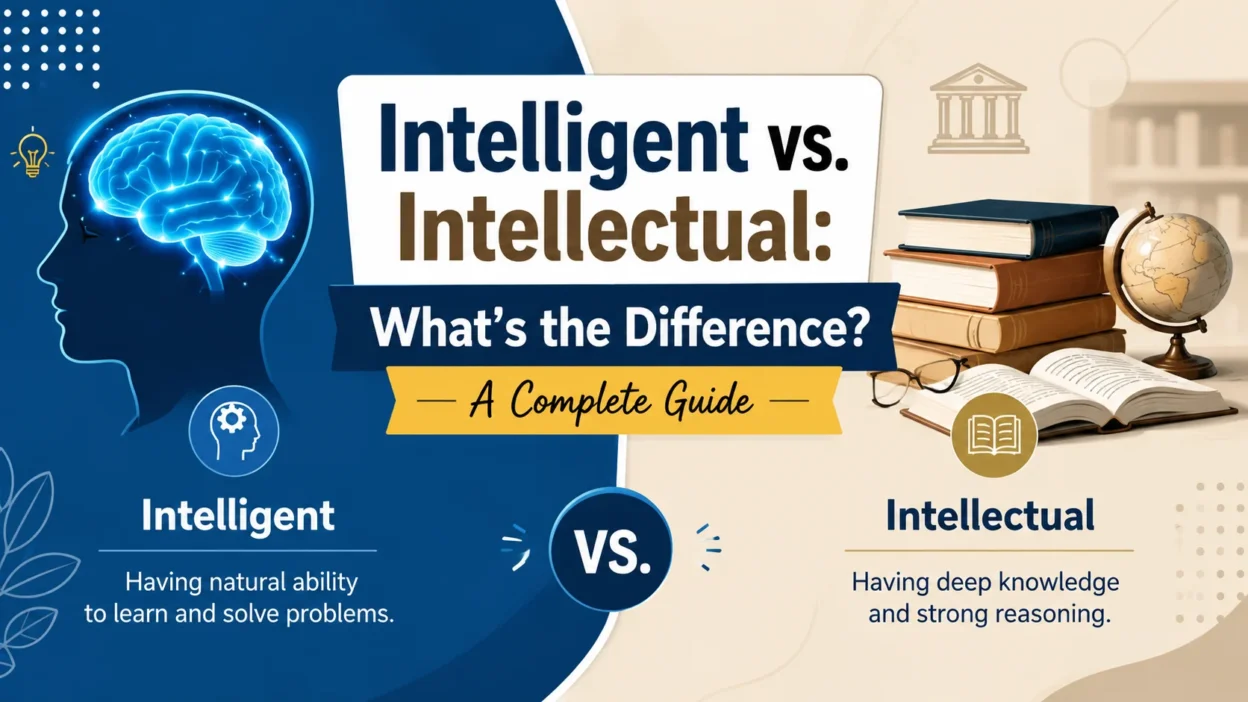
Intelligent vs. Intellectual shows the difference between mental ability and interest in ideas, learning, and knowledge. An intelligent person understands ideas quickly, solves problems effectively, and makes good decisions in different situations. Intelligence, reasoning, critical thinking, and problem-solving help someone navigate challenges, grasp complex ideas, and respond instantly. For English learners, this distinction makes it easier to choose the right word.
An intellectual person enjoys studying, learning, reading books, discussing ideas, and thinking critically about various topics. Their intellectual interests may include literature, science, philosophy, history, culture, research, and abstract concepts. Intellectuals often enjoy deep thinking, analysis, and intellectual pursuits. However, intelligent and intellectual don’t have the same meaning. They describe different qualities, abilities, and interests.
In everyday English, this distinction helps you communicate accurately and choose the right word for each context. Intelligent usually describes someone’s ability to learn, reason, and solve problems, while intellectual relates more to ideas, learning, and complex subjects. Understanding this key difference improves your vocabulary, writing, and speaking skills in education, professional settings, and everyday conversations..
Intelligent vs. Intellectual at a Glance
The easiest way to remember the difference is this:
Intelligent describes mental ability. Intellectual often describes engagement with ideas and knowledge.
| Feature | Intelligent | Intellectual |
| Basic meaning | Able to learn, understand, reason, or solve problems | Connected with thinking, ideas, knowledge, or careful study |
| Main focus | Mental ability | Ideas, learning, and mental interests |
| Commonly describes | People, decisions, questions, solutions, behavior | People, discussions, interests, activities, subjects |
| Practical situations | Very common | Less common |
| Academic connection | Possible but not required | Often strong |
| Example | “She’s highly intelligent.” | “He has strong intellectual interests.” |
Cambridge Dictionary defines intelligent as showing intelligence or being able to learn and understand things easily. It defines intellectual as relating to the ability to think and understand, especially complicated ideas, and also uses it for someone who is highly educated and interested in studying and careful thinking.
So, while the meanings overlap, the emphasis changes.
What Does “Intelligent” Mean?
Intelligent is an adjective that describes someone or something showing intelligence. When you call someone intelligent, you’re generally commenting on their ability to understand information, learn, reason, make judgments, or deal with problems effectively.
For example:
- She’s an intelligent student.
- That was an intelligent decision.
- He asked an intelligent question.
- We need an intelligent solution to this problem.
- The team took an intelligent approach to the situation.
The word can apply to more than people. You can have an intelligent answer, intelligent strategy, intelligent system, or intelligent design.
Definition of Intelligent
Cambridge Dictionary describes intelligent as showing intelligence or having the ability to learn and understand things easily. Its American Dictionary gives a similar meaning, emphasizing the ability to understand and learn well.
The related noun intelligence refers to the ability to learn, understand, and make judgments or opinions based on reason.
In practical terms, intelligence can show itself through:
- Learning quickly
- Recognizing patterns
- Understanding difficult information
- Reasoning through problems
- Making sensible judgments
- Adapting to unfamiliar situations
- Applying knowledge effectively
What Does an Intelligent Person Do?
An intelligent person doesn’t necessarily know everything. Instead, they tend to process information effectively.
Imagine that a machine suddenly stops working at a small business. One person might immediately panic. Another might calmly identify the symptoms, check the likely causes, and find a workable solution.
That second person is demonstrating intelligence in a practical setting.
Intelligence isn’t simply about memorizing facts. Knowing hundreds of facts can be useful, but understanding how those facts fit together is often more important.
How “Intelligent” Is Used in Everyday English
Intelligent is common in everyday English because it can describe both people and actions.
Some common combinations include:
- intelligent person
- intelligent child
- intelligent decision
- intelligent question
- intelligent response
- intelligent solution
- intelligent approach
- highly intelligent
- artificially intelligent
- intelligent system
Notice something important: intelligent can evaluate an action or result, not just a person’s mental ability.
For example, saying “That was an intelligent decision” means the decision showed good reasoning or judgment.
Examples of “Intelligent” in Sentences
- Maya is an intelligent student who understands new concepts quickly.
- That was an intelligent way to solve the problem.
- He asked an intelligent question during the meeting.
- You don’t need advanced training to make an intelligent choice.
- The manager made an intelligent decision after reviewing the data.
What Does “Intellectual” Mean?
Intellectual also relates to the mind, but its meaning usually moves toward ideas, knowledge, complex subjects, and thoughtful mental activity.
For example:
- intellectual curiosity
- intellectual discussion
- intellectual challenge
- intellectual interests
- intellectual development
- intellectual debate
- intellectual property
- intellectual history
Cambridge Dictionary gives two especially useful senses. First, intellectual can mean relating to the ability to think and understand complicated ideas. Second, it can describe someone who is highly educated and interested in studying and careful thinking.
The word can also function as a noun.
An intellectual is generally a person whose life or work centers on studying, discussing, or developing ideas. Cambridge describes the noun as someone very educated who is interested in complicated ideas and careful thinking.
Definition of Intellectual
The key idea behind intellectual is not simply being smart.
Instead, it often points toward engagement with ideas.
Someone might spend hours reading philosophy, studying history, analyzing political theories, discussing literature, or exploring scientific concepts. That person may be described as intellectual because of their interests and habits of thought.
Common examples include:
- intellectual curiosity
- intellectual stimulation
- intellectual work
- intellectual discussion
- intellectual rigor
- intellectual debate
- intellectual pursuit
What Is an Intellectual Person Like?
An intellectual person often enjoys going beneath the surface.
Instead of asking only “What happened?”, they may want to know “Why did it happen?”, “What does it mean?”, and “What are the wider consequences?”
For example, someone interested in history might not simply memorize dates. They may examine why societies changed, how political ideas developed, and how those events influenced modern life.
That curiosity is an important part of the word intellectual.
How “Intellectual” Is Used in Everyday English
You might hear intellectual in conversations about:
- Books
- Philosophy
- History
- Science
- Politics
- Literature
- Art
- Education
- Research
- Culture
- Complex ideas
However, intellectual doesn’t always mean serious or academic.
For example, an intellectual challenge can simply be something that makes you think deeply.
Examples of “Intellectual” in Sentences
- She has a strong intellectual curiosity about ancient civilizations.
- The course provides plenty of intellectual stimulation.
- They had an intellectual discussion about free will.
- His interests are both artistic and intellectual.
- The professor encouraged students to question established ideas.
- She became known as an intellectual because of her writing and scholarship.
Intelligent vs. Intellectual: Key Differences
The distinction becomes much easier once you separate ability from engagement.
Mental Ability vs. Interest in Ideas
Intelligent focuses primarily on mental ability.
If you say, “Jordan is intelligent,” you’re saying Jordan has strong cognitive abilities or demonstrates good understanding and reasoning.
Intellectual, on the other hand, often focuses on a person’s relationship with ideas.
If you say, “Jordan is intellectual,” you may be describing someone who enjoys studying, discussing, or exploring complicated subjects.
That’s a subtle but meaningful difference.
Ability vs. Engagement
Think of it this way:
Intelligence is about what your mind can do.
Intellectual interests are about what your mind chooses to explore.
A person could have excellent problem-solving skills but spend very little time reading philosophy, studying history, or discussing abstract theories.
That person can still be highly intelligent.
Problem-Solving vs. Deep Thinking
Imagine two people repairing a broken car.
The first person quickly identifies the mechanical problem and fixes it. That’s a good example of intelligent problem-solving.
The second person enjoys discussing how transportation technology developed, why engines work the way they do, and how transportation has changed society.
That interest is more intellectual.
Of course, one person can easily be both.
Broad Ability vs. Academic or Cultural Interests
Intelligence isn’t limited to classrooms.
A skilled mechanic, entrepreneur, athlete, designer, programmer, or emergency responder may demonstrate impressive intelligence through practical decisions and rapid adaptation.
The word intellectual more often appears when the subject involves ideas, education, scholarship, culture, or complex mental discussion.
That doesn’t make one type of person better.
They’re simply different dimensions.
Describing Ability vs. Describing Character or Interests
Compare these sentences:
“She is intelligent.”
This directly comments on her mental ability.
“She is intellectual.”
This can suggest that she is interested in ideas, learning, study, or serious mental discussion.
The second sentence may also describe a person’s general style or identity. That’s why intellectual can function as a noun as well as an adjective.
Intelligent vs. Intellectual: Are They Interchangeable?
Not always.
Consider these examples:
“He made an intelligent decision.”
This means the decision was sensible or well-reasoned.
You wouldn’t normally replace intelligent with intellectual:
“He made an intellectual decision.”
That sentence is possible in a specialized context, but it doesn’t naturally express the same idea.
Now compare:
“She has intellectual curiosity.”
Replacing it with intelligent curiosity changes the meaning and sounds unnatural.
This is why choosing between the two words requires attention to the noun that follows them.
Can Someone Be Intelligent Without Being Intellectual?
Yes. Absolutely.
A person can be highly intelligent while having little interest in academic or theoretical subjects.
Consider a successful restaurant owner who can quickly analyze customer behavior, manage costs, solve staffing problems, and adjust a menu when sales change.
That person may demonstrate considerable intelligence.
However, they might never want to spend an evening discussing philosophy or reading a dense history book. That doesn’t make them less intelligent.
Real-Life Example
Imagine a carpenter who can look at a complicated structure and immediately understand how to build it.
They may have:
- Excellent spatial reasoning
- Strong practical judgment
- Problem-solving ability
- Technical knowledge
- Adaptability
- Creativity
Those abilities can reflect intelligence even if the person has no particular interest in academic discussions.
Why Intelligence Doesn’t Require Academic Interests
Traditional education is only one environment in which intelligence appears.
People solve problems in workshops, kitchens, hospitals, offices, construction sites, laboratories, stores, homes, and countless other places.
A person doesn’t need to be an avid reader or academic researcher to think intelligently.
Can Someone Be Intellectual Without Being Highly Intelligent?
The answer requires a little nuance.
Intellectual doesn’t function as a precise score of mental ability. It can describe someone’s interests, education, habits, or involvement with ideas.
For example, someone might love philosophy and read difficult books every day. They could participate in intellectual discussions and be described as intellectual.
That doesn’t automatically tell you how they would perform on every measure of cognitive ability.
The reverse is also true. A person with strong reasoning skills might have no interest in intellectual culture.
So these terms overlap without being identical.
Types of Intelligence and Intellectual Interests
It’s useful to avoid treating intelligence as one narrow ability.
People can demonstrate different strengths, including:
- Practical intelligence: Applying knowledge to real-world problems.
- Analytical ability: Breaking complicated information into understandable parts.
- Creative thinking: Generating original ideas or approaches.
- Social intelligence: Reading social situations and responding effectively.
- Emotional intelligence: Recognizing and managing emotions in oneself and others.
These abilities don’t automatically make someone an intellectual.
For example, someone can have excellent social intelligence while rarely engaging with academic or abstract ideas.
Likewise, a person can have strong intellectual interests while still needing to develop practical or social skills.
Intelligent vs. Intellectual in Different Contexts
The context often tells you which word fits best.
In School and Education
In education, both words can appear frequently.
A student may be intelligent because they understand difficult concepts quickly.
A student may be intellectual because they enjoy exploring theories, reading beyond the syllabus, and discussing complicated ideas.
For example:
“David is an intelligent student.”
This emphasizes ability.
“David has strong intellectual interests.”
This emphasizes curiosity and engagement with ideas.
At Work
At work, intelligent is often the more natural choice when discussing performance.
You might say:
- She made an intelligent decision.
- He’s an intelligent problem-solver.
- That’s an intelligent business strategy.
Intellectual becomes more natural when the work involves research, theory, scholarship, or complex conceptual analysis.
For example:
“The position offers an intellectual challenge.”
Here, the job requires sustained thinking rather than simply quick decision-making.
In Business
Business writing often uses intelligent for practical decisions and systems.
Examples include:
- intelligent strategy
- intelligent automation
- intelligent software
- intelligent decision-making
- intelligent investment
Intellectual appears in areas involving ideas, research, and legal concepts.
One particularly common phrase is intellectual property, which covers creations of the mind such as inventions, literary and artistic works, designs, and certain commercial identifiers.
In Daily Life
For everyday conversation, intelligent is usually the safer choice when praising someone’s thinking.
You might say:
“She’s incredibly intelligent.”
Calling someone intellectual can sound more specific. It may suggest that the person enjoys academic, cultural, or theoretical subjects.
In Literature, Philosophy, and Culture
This is where intellectual becomes especially useful.
You can discuss:
- intellectual history
- intellectual movements
- intellectual debate
- intellectual traditions
- intellectual culture
- intellectual curiosity
These phrases focus on ideas and their development rather than simply measuring someone’s ability to reason.
Common Collocations With “Intelligent”
Learning common word combinations can make the distinction much easier.
Common “Intelligent” Phrases
- highly intelligent person
- intelligent child
- intelligent decision
- intelligent choice
- intelligent question
- intelligent response
- intelligent solution
- intelligent approach
- intelligent behavior
- intelligent system
These expressions usually point toward good reasoning, understanding, judgment, or performance.
Common Collocations With “Intellectual”
Common “Intellectual” Phrases
- intellectual curiosity
- intellectual property
- intellectual challenge
- intellectual discussion
- intellectual debate
- intellectual interests
- intellectual development
- intellectual pursuit
- intellectual stimulation
- intellectual rigor
- public intellectual
These combinations tend to involve ideas, knowledge, learning, scholarship, or complex thought.
Common Mistakes With Intelligent and Intellectual
The biggest mistake is treating the two words as perfect synonyms.
Here are several errors worth avoiding:
- Assuming intelligent means academic: Intelligence can appear in practical situations.
- Assuming intellectual means smarter: Intellectual usually describes interests or engagement with ideas rather than providing a precise measure of intelligence.
- Using intellectual for every smart person: Someone can be intelligent without having intellectual interests.
- Using intelligent for academic interests: “Intellectual curiosity” is natural, while “intelligent curiosity” usually isn’t.
- Assuming intellectual is always a compliment: Depending on context, it can describe a style or identity rather than praise someone’s overall ability.
Conclusion
Understanding Intelligent vs. Intellectual becomes easier when you focus on the main difference. Intelligent describes someone’s ability to learn, reason, understand, and solve problems. Intellectual usually describes a strong interest in ideas, knowledge, learning, research, and deep thinking. A person can be intelligent without being intellectual, or they can be both.
FAQs
Q1. What is the difference between intelligent and intellectual?
Intelligent describes mental ability, while intellectual usually describes interest in ideas, knowledge, learning, and deeper thinking.
Q2. Can someone be intelligent but not intellectual?
Yes. Someone may be excellent at problem-solving and practical decisions without having strong academic or intellectual interests.
Q3. Can someone be both intelligent and intellectual?
Yes. A person can have strong intelligence while also enjoying philosophy, science, literature, research, and other intellectual pursuits.
Q4. Is intellectual the same as intelligent?
No. Although the words overlap, intelligent focuses more on ability, while intellectual focuses more on ideas, learning, and mental interests.
Q5. Does intellectual mean highly intelligent?
Not necessarily. Intellectual can describe someone’s interests, education, or engagement with complex ideas rather than their exact level of intelligence.
Q6. Which word is better for everyday English?
Intelligent is more natural when describing someone’s ability or judgment. Intellectual works better when discussing ideas, academic interests, or deep thinking.
Q7. How can I remember the difference between intelligent and intellectual?
Use this simple rule: intelligent = mental ability, while intellectual = interest in ideas and knowledge.