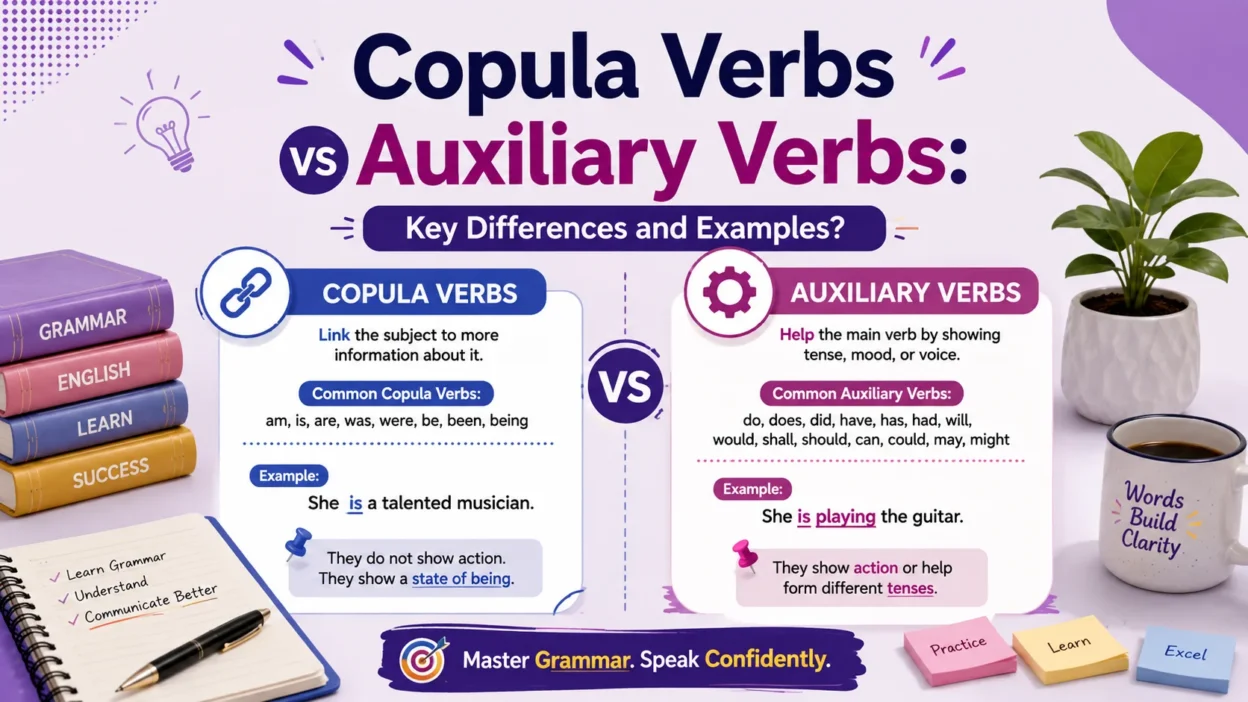
Copula Verbs vs Auxiliary Verbs make English grammar easier by helping learners understand verb functions, sentence meaning, and correct usage. A copula verb, also called a linking verb, connects the subject with a subject complement to show identity, condition, or description instead of an action.
An auxiliary verb, also known as a helping verb, works with the main verb to express tense, aspect, mood, voice, questions, and emphasis. Common forms include be, is, am, are, was, were, have, has, had, do, will, can, and must. For example, “She is happy” uses a copula, while “She is running” uses an auxiliary in the present continuous tense.
From editing professional emails, school assignments, and English proficiency exams, I have found that many grammar mistakes come from confusing these verbs. Studying examples, making a simple comparison, and doing regular practice will help you recognize the difference and improve grammar, writing, speaking, and language proficiency, leading to more accurate, natural, and effective communication while avoiding common mistakes.
Quick Answer: Copula Verbs vs Auxiliary Verbs
The main difference is simple.
A copula verb connects the subject to a subject complement, which describes or identifies the subject.
An auxiliary verb helps another main verb express grammatical meaning such as tense, aspect, voice, possibility, obligation, or ability.
Consider these examples:
| Sentence | Verb Type | Explanation |
| Sarah is happy. | Copula | Is links Sarah to the adjective happy. |
| Sarah is running. | Auxiliary | Is helps form the present continuous tense. |
| The soup tastes delicious. | Copula | Tastes connects the subject with its description. |
| They have finished the project. | Auxiliary | Have helps form the present perfect tense. |
The easiest way to tell the difference is to look for another main verb. If another verb follows, the first verb usually acts as an auxiliary. If the verb directly connects the subject to a noun, adjective, or pronoun, it’s functioning as a copula.
Copula vs Auxiliary Verbs at a Glance
| Feature | Copula Verbs | Auxiliary Verbs |
| Main purpose | Link the subject to a complement | Help the main verb |
| Express action | No | No |
| Need another main verb | No | Yes |
| Connect subject to description | Yes | No |
| Help create verb tenses | No | Yes |
| Examples | be, seem, become, remain | be, have, do, can, should |
What Are Verbs in English Grammar?
Every complete sentence needs a verb. Verbs tell us what happens, what exists, or what state someone or something is in.
English grammar groups verbs into several categories. Understanding these categories makes it much easier to distinguish between copula and auxiliary verbs.
Main (Lexical) Verbs
A main verb carries the sentence’s primary meaning. It expresses an action, event, or state.
Examples:
- Emma writes every morning.
- Birds fly south in winter.
- They built a new bridge.
- The baby slept peacefully.
Each sentence contains only one main action.
Helping (Auxiliary) Verbs
Helping verbs support the main verb rather than replacing it.
They help express:
- Time
- Duration
- Completion
- Possibility
- Necessity
- Permission
- Obligation
- Voice
Examples:
- She has finished her homework.
- They are traveling tomorrow.
- You should study tonight.
- We did not arrive on time.
Without the auxiliary verb, the sentence often loses important grammatical meaning.
Linking (Copula) Verbs
Unlike action verbs, linking verbs don’t show what someone does.
Instead, they connect the subject with information about the subject.
Examples:
- The weather is beautiful.
- My brother became a doctor.
- The room looks clean.
- The milk smells sour.
Notice that none of these verbs describe an action. They simply link the subject to additional information.
What Is a Copula Verb?
A copula verb, also called a linking verb, connects the subject of a sentence to a word or phrase that identifies, renames, or describes it.
Instead of showing action, the copula creates a relationship between two parts of the sentence.
For example:
- Lisa is a teacher.
- The sky became dark.
- This idea sounds interesting.
- Your answer seems correct.
In each example, the verb links the subject to a complement.
What a Copula Verb Does
A copula performs three important functions.
It can:
- Identify the subject.
- Describe the subject.
- Show a change in condition or state.
Examples:
| Sentence | Subject Complement |
| Jack is an engineer. | engineer |
| The flowers are beautiful. | beautiful |
| She became confident. | confident |
| The soup tastes salty. | salty |
Notice that the complement always refers back to the subject.
Basic Copula Formula
The basic sentence pattern is straightforward.
Subject + Copula Verb + Subject Complement
Examples:
- My father is a pilot.
- The meeting was successful.
- Your idea sounds practical.
- The child became sleepy.
This structure appears constantly in everyday English.
Why It’s Called a Linking Verb
The word linking explains exactly what this verb does.
Instead of expressing action, it links two pieces of information.
Think of the verb as a bridge.
Subject → Copula Verb → Description
For example:
The cake → smells → wonderful
The verb doesn’t describe an action. It connects cake with wonderful.
Common Copula Verbs
Many people think only be functions as a copula.
In reality, English contains many linking verbs.
Some appear frequently in everyday conversation while others occur mainly in formal writing.
Forms of Be
The most common copula verb is be.
Its forms include:
- am
- is
- are
- was
- were
- be
- been
- being
Examples:
- I am ready.
- She is confident.
- They were excited.
- The results have been excellent.
- Stop being impatient.
Every one of these examples links the subject to a description rather than expressing an action.
Other Linking (Copular) Verbs
Many verbs become copulas when they describe a condition instead of an action.
Common examples include:
- become
- seem
- appear
- remain
- stay
- look
- sound
- smell
- taste
- feel
- grow
- turn
- prove
Examples:
- He became famous.
- The answer seems obvious.
- You look tired.
- The flowers smell wonderful.
- The coffee tastes bitter.
- The room remains quiet.
- The leaves turned yellow.
These verbs help describe the subject rather than showing what it does.
Which Verbs Can Be Copular Only in Certain Contexts?
Some verbs change roles depending on the sentence.
Compare these examples.
| Sentence | Function |
| She looks happy. | Copula |
| She looked at me. | Action verb |
| The soup tastes delicious. | Copula |
| He tasted the soup. | Action verb |
| The flowers smell fresh. | Copula |
| She smelled the perfume. | Action verb |
This flexibility explains why English learners often become confused.
Quick Tip: If the verb can be replaced by is without changing the basic meaning, it’s probably acting as a copula.
Example:
- The soup tastes delicious.
- The soup is delicious.
The meaning stays nearly identical.
What Is an Auxiliary Verb?
An auxiliary verb—often called a helping verb—works with a main verb to create different verb forms.
Unlike copula verbs, auxiliary verbs don’t describe the subject.
Instead, they help express grammatical meaning.
Examples:
- She is studying.
- They have arrived.
- We do understand.
- You must leave.
Each helping verb supports another verb.
Without the main verb, the sentence becomes incomplete.
Auxiliary Verb Formula
Most auxiliary structures follow this pattern.
Subject + Auxiliary Verb + Main Verb
Examples:
- I have completed the report.
- They are playing soccer.
- She can swim.
- We will travel tomorrow.
The auxiliary always works alongside another verb.
Why Auxiliary Verbs Matter in English
Auxiliary verbs make English more flexible and expressive.
They help create:
- Progressive tenses
- Perfect tenses
- Passive voice
- Questions
- Negative sentences
- Modal meaning
Consider these examples.
Present Continuous
- She is reading.
Present Perfect
- They have finished.
Future
- We will arrive soon.
Passive Voice
- The letter was written yesterday.
Question
- Do you understand?
Negative
- She doesn’t like coffee.
Without auxiliaries, many of these structures wouldn’t exist.
Types of Auxiliary Verbs
English auxiliary verbs fall into three major groups.
Learning each group makes grammar much easier to understand.
Primary Auxiliary Verbs
English has three primary auxiliary verbs.
- Be
- Have
- Do
Each serves a different purpose.
Be
The auxiliary be creates continuous tenses and passive voice.
Examples:
- She is cooking dinner.
- They were waiting outside.
- The house was built in 1998.
- The project is being completed today.
Have
The auxiliary have forms perfect tenses.
Examples:
- I have finished my work.
- She had left before noon.
- They have been studying all afternoon.
- We had completed the project.
Perfect tenses emphasize completion or connection to another point in time.
Do
The auxiliary do supports questions, negatives, and emphasis.
Examples:
- Do you agree?
- She doesn’t drive.
- They did call yesterday.
- I do appreciate your help.
Notice that do doesn’t add meaning by itself. Instead, it supports the main verb grammatically.
Modal Auxiliary Verbs
Modal auxiliaries express ideas such as possibility, permission, obligation, necessity, advice, willingness, or ability.
The most common modal verbs include:
- can
- could
- may
- might
- must
- shall
- should
- will
- would
- ought to
Examples:
| Modal | Example | Meaning |
| Can | She can speak French. | Ability |
| Could | We could leave now. | Possibility |
| May | You may enter. | Permission |
| Might | It might rain later. | Uncertainty |
| Must | You must wear a helmet. | Obligation |
| Should | You should exercise daily. | Advice |
| Will | I will call tomorrow. | Future |
| Would | They would help if asked. | Hypothetical situation |
Modal verbs never change form based on the subject. They also appear directly before the base form of the main verb.
Semi-Modal Verbs
Some expressions behave like modal verbs even though they contain more than one word.
These are called semi-modals.
Common examples include:
- have to
- need to
- used to
- be able to
Examples:
- I have to finish this report today.
- She needs to improve her pronunciation.
- They used to live in Boston.
- We are able to solve the problem quickly.
Although semi-modals don’t function exactly like traditional modal auxiliaries, they express similar meanings such as necessity, ability, habit, and obligation. They appear frequently in both spoken and written English and deserve the same level of attention when learning English grammar.
Copula Verbs vs Auxiliary Verbs: Key Differences
Although copula verbs and auxiliary verbs sometimes use the same word, they have different jobs in a sentence. A copula verb connects the subject to a description or identity, while an auxiliary verb helps another verb express tense, mood, or voice.
| Feature | Copula Verbs | Auxiliary Verbs |
| Purpose | Link the subject to a complement | Help the main verb |
| Main role | Describe or identify | Form verb phrases |
| Needs another verb | No | Yes |
| Examples | is, seem, become | is, have, do, can |
Copula Verb Example
- Emma is kind.
- The soup tastes delicious.
- My uncle became a doctor.
These verbs connect the subject to additional information.
Auxiliary Verb Example
- Emma is reading a book.
- They have finished dinner.
- You should study tonight.
Here, the auxiliary verb supports the main verb.
The Special Case of Be
The verb be can work as either a copula or an auxiliary. Its function depends on what comes after it.
When Be Is a Copula Verb
If be links the subject to a noun or adjective, it acts as a copula.
Examples:
- She is happy.
- David is a teacher.
- The weather was cold.
When Be Is an Auxiliary Verb
If another verb follows be, it functions as an auxiliary.
Examples:
- She is running.
- They were watching TV.
- The report was completed yesterday.
Subject Complements in Copula Verbs
A subject complement follows a copula verb and describes or renames the subject.
Predicate Nouns
A predicate noun gives the subject another name.
Examples:
- Sarah is a nurse.
- John became the captain.
Predicate Adjectives
A predicate adjective describes the subject.
Examples:
- The sky is blue.
- The food looks fresh.
- Your idea sounds great.
Sentence Patterns
Learning common sentence patterns makes it easier to identify verb types.
Copula Verb Pattern
Subject + Copula Verb + Subject Complement
Examples:
- The room is quiet.
- My brother became an engineer.
Auxiliary Verb Pattern
Subject + Auxiliary Verb + Main Verb
Examples:
- The room is getting quieter.
- My brother has become an engineer.
How to Identify Copula and Auxiliary Verbs
You can identify the verb type by asking a few simple questions.
Does the Verb Describe the Subject?
If it describes or renames the subject, it’s a copula.
Example:
- The cake is fresh.
Does Another Verb Follow?
If another verb comes after it, it’s usually an auxiliary.
Example:
- The cake is baking.
Is It Forming a Tense?
Helping verbs create verb tenses.
Examples:
- has finished
- is studying
- had left
Common Mistakes
Many learners confuse these verbs because be performs two different roles.
Mistaking Be for an Auxiliary Every Time
Incorrect idea:
- Every is is a helping verb.
Correct examples:
- She is friendly. (Copula)
- She is working. (Auxiliary)
Confusing Linking Verbs with Action Verbs
Compare these sentences:
- The flowers smell wonderful. (Copula)
- She smelled the flowers. (Action verb)
The same verb can have different functions depending on the sentence.
Real-Life Examples
Seeing these verbs in context makes the difference easier to understand.
Everyday English
- You look tired.
- I have finished my homework.
- The coffee is hot.
- We are leaving now.
Academic Writing
- The experiment was successful.
- Researchers have discovered new evidence.
Business English
- Our proposal is competitive.
- The team has completed the project.
Practice Exercises
Identify the Copula Verb
Which sentence contains a copula verb?
- The baby is sleeping.
- The baby is happy.
- The baby has cried.
Answer: The baby is happy.
Identify the Auxiliary Verb
Which sentence contains an auxiliary verb?
- She seems confident.
- She is preparing dinner.
- She became famous.
Answer: She is preparing dinner.
Quick Practice Table
| Sentence | Answer |
| He is tall. | Copula |
| He is running. | Auxiliary |
| They became doctors. | Copula |
| They have arrived. | Auxiliary |
| You should study. | Auxiliary |
| The soup smells delicious. | Copula |
Quick Memory Tricks
These simple tricks help you remember the difference.
Copula = Connects
A copula verb connects the subject to a description or identity.
Auxiliary = Assists
An auxiliary verb helps another verb form the correct tense or meaning.
The “Another Verb” Test
Ask yourself:
- Another verb follows? → Auxiliary verb.
- No other verb? → Copula verb if it links the subject to a complement.
Conclusion
Understanding the difference between Copula Verbs and Auxiliary Verbs helps you build stronger English grammar skills. Once you know when a verb links the subject to a description and when it helps a main verb, your writing, speaking, and communication become more accurate, natural, and confident. With regular practice and real-life examples, using these verbs correctly becomes much easier.
FAQs
Q1. What is the main difference between Copula Verbs and Auxiliary Verbs?
A copula verb connects the subject to a subject complement, while an auxiliary verb helps the main verb express tense, aspect, mood, or voice.
Q2. Can be be both a copula verb and an auxiliary verb?
Yes. Be is a copula verb in “She is happy,” but it is an auxiliary verb in “She is running.”
Q3. Why do learners confuse these verbs?
Many learners focus only on the verb form instead of its function. Looking at the sentence structure and meaning makes the difference much clearer.
Q4. How can I identify a copula verb?
If the verb connects the subject to an adjective, noun, or description rather than showing an action, it is usually a copula verb.
Q5. How can I master Copula Verbs vs Auxiliary Verbs?
Read plenty of examples, compare different sentence patterns, and practice writing and speaking regularly. This improves grammar skills, communication, and overall English proficiency.