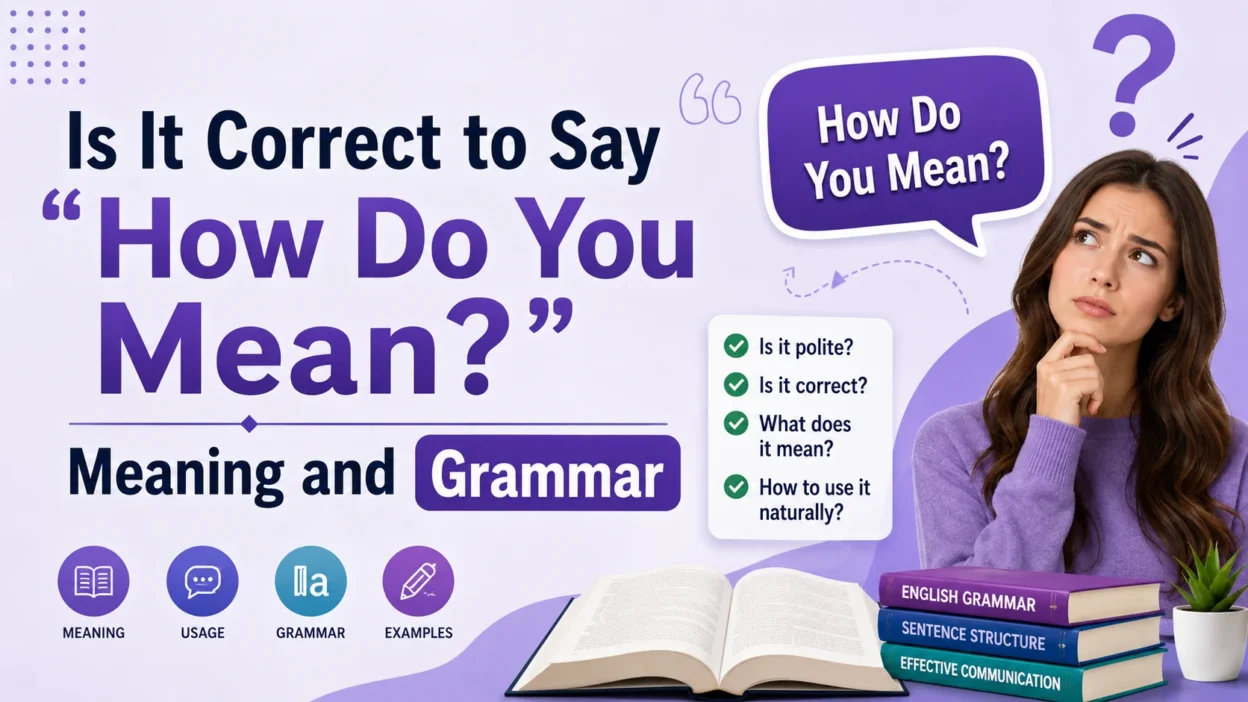
The phrase Is It Correct To Say “How Do You Mean?” raises questions because learners compare its grammar, meaning, and use in English conversations. The answer is yes because How Do You Mean is a correct English expression with a clear purpose. Although What Do You Mean appears more often in American English and everyday English, the phrase remains a valid part of real English. In British English, many native speakers use it naturally during spoken English, conversation, and formal discussions when they want an explanation of someone’s reasoning or perspective.
Good communication requires more than memorizing one phrase. It depends on communication skills, communication style, effective communication, and awareness of social context and cultural context. During a daily conversation, natural conversation, or conversational dialogue, the speaker, listener, and audience all influence how a message is understood. Strong comprehension, interpretation, clarification, and response create better interaction and effective exchange.
Choosing between “How do you mean?” and “What do you mean?” depends on intent, nuance, clarity, and purpose rather than simple right or wrong rules. A simple question may work in casual situations, while a deeper explanation may be needed in discussion, dialogue, or professional settings. Using a reliable guide or usage guide can explain when to use and when to avoid certain expressions, but real-life examples from movies, literature, and classrooms often show how language works.
Quick Answer: Is “How Do You Mean?” Correct?
Yes. “How do you mean?” is grammatically correct English.
The expression asks someone to clarify what they mean or explain the way they intended their statement to be understood. Instead of asking for repetition, it asks for interpretation, reasoning, or perspective.
For example:
Sarah: I don’t think that’s the best solution.
James: How do you mean?
James isn’t asking Sarah to repeat herself. He’s asking her to explain why she believes that.
Quick facts
| Question | Answer |
| Is it grammatically correct? | Yes |
| Is it common in American English? | Less common |
| Is it common in British English? | More common |
| Does it ask for clarification? | Yes |
| Is it interchangeable with “What do you mean?” | Sometimes, but not always |
One important point often gets overlooked. Correct grammar doesn’t always mean common usage. English contains many expressions that are perfectly grammatical but less frequent in everyday speech.
What Does “How Do You Mean?” Mean?
The phrase “How do you mean?” asks another person to explain how they intend their words to be understood.
Rather than questioning the words themselves, the speaker asks about the intended meaning, reasoning, or point of view.
Simple definition
How do you mean?
Meaning: Can you explain exactly what you mean?
It functions as a request for clarification after hearing something surprising, unclear, or open to interpretation.
The implied meaning behind the question
English speakers often leave parts of a sentence unstated because the context fills in the missing information.
When someone says:
“How do you mean?”
The complete idea is closer to:
- How do you mean that?
- How should I understand what you just said?
- In what sense do you mean it?
This makes the question more about interpretation than vocabulary.
Why it asks for clarification instead of repetition
Suppose someone says:
“This project could become a problem.”
There are many possible meanings.
- The budget may be too small.
- The deadline may be unrealistic.
- The client may change the requirements.
- The team may lack experience.
If you ask:
How do you mean?
You’re inviting the speaker to explain which concern they have in mind.
That’s different from asking them to repeat their sentence.
Is “How Do You Mean?” Grammatically Correct?
Absolutely.
From a grammatical perspective, the sentence follows the standard structure of an English interrogative.
Grammar breakdown
| Word | Function |
| How | Interrogative adverb |
| Do | Auxiliary verb |
| You | Subject |
| Mean | Main verb |
Sentence pattern:
How + do + subject + base verb
This pattern appears throughout English.
Examples include:
- How do you know?
- How do you feel?
- How do you decide?
- How do you remember that?
The only difference lies in the verb mean, which asks about intended interpretation.
Why the sentence is valid English
The verb mean can describe intention.
Consider these examples:
- What do you mean?
- I didn’t mean that.
- That’s not what I meant.
- What exactly did you mean?
Since meaning can involve intention or interpretation, asking how someone means something naturally focuses on the manner or sense in which they intend it.
Why correctness and frequency are different
Many learners confuse correctness with popularity.
These ideas aren’t the same.
For example:
| Expression | Grammatically correct | Common today |
| How do you mean? | Yes | Less common |
| What do you mean? | Yes | Very common |
| Might I ask…? | Yes | Less common |
| Can I ask…? | Yes | Very common |
Language evolves.
Some expressions become favorites while others remain perfectly correct but appear less often.
Common grammar misconceptions
One misconception says “How do you mean?” should always be replaced with “What do you mean?”
That’s not entirely true.
Although both expressions request clarification, they focus on slightly different aspects of communication.
Another misconception claims “How do you mean?” is outdated.
While it isn’t as frequent in American speech, it still appears in modern British conversations, novels, interviews, and thoughtful discussions.
Why “How Do You Mean?” Sounds Unusual to Many Speakers
If the phrase is correct, why does it sound unfamiliar?
The answer lies in language habits, not grammar.
Native speakers tend to repeat expressions they hear most often.
In the United States, people overwhelmingly say:
- What do you mean?
- Can you explain?
- Could you clarify?
Because these phrases dominate everyday conversation, “How do you mean?” naturally feels less familiar.
Frequency in modern English
Modern spoken English favors direct clarification questions.
People often choose expressions that require less thought from the listener.
Instead of saying:
How do you mean?
Many speakers simply ask:
What do you mean?
Both questions seek clarification, but the second has become the everyday standard.
Influence of regional English
English isn’t identical across the world.
Each region develops its own preferred vocabulary and expressions.
For example:
| Region | Preferred expression |
| United States | What do you mean? |
| Canada | What do you mean? |
| Australia | Mostly “What do you mean?” with occasional “How do you mean?” |
| United Kingdom | Both expressions appear naturally |
This explains why British novels often contain expressions that sound unusual to American readers.
Preference for “What Do You Mean?” in everyday conversation
American English generally values efficiency.
Instead of exploring how someone intended a statement, speakers usually ask directly what the statement means.
That’s why you’ll hear conversations like this:
“What do you mean?”
far more often than:
“How do you mean?”
Context affects naturalness
Even in Britain, context matters.
Imagine these situations.
Someone says:
“That decision worries me.”
If you respond:
“How do you mean?”
the conversation feels thoughtful.
If someone shouts:
“Fire!”
asking:
“How do you mean?”
would sound completely unnatural.
Urgency changes language.
Natural English depends as much on context as grammar.
British English vs American English
Regional variation plays a significant role in how English speakers perceive certain expressions.
“How do you mean?” provides an excellent example.
Usage in British English
British speakers often use the phrase when they want another person to expand on an idea.
Rather than sounding strange, it can sound measured and polite.
Example:
“I’m not sure that’s the right conclusion.”
“How do you mean?”
The speaker requests additional explanation without challenging the other person’s opinion.
Usage in American English
In the United States, the same situation usually sounds like this:
“I’m not sure that’s the right conclusion.”
“What do you mean?”
American speakers generally reserve “How do you mean?” for literary dialogue, formal discussion, or speakers influenced by British English.
Other English-speaking countries
Countries such as Australia, New Zealand, and Ireland often understand both expressions without difficulty.
However, usage still leans toward “What do you mean?” because American media strongly influences everyday speech.
Regional comparison table
| Region | How do you mean? | What do you mean? |
| United States | Rare | Very common |
| United Kingdom | Common | Common |
| Canada | Less common | Very common |
| Australia | Occasional | Very common |
| New Zealand | Occasional | Very common |
| Ireland | Fairly common | Common |
Understanding these regional preferences helps you choose language that sounds natural to your audience.
If you’re writing for American readers, “What do you mean?” usually sounds more familiar.
If you’re speaking with British colleagues or reading British literature, “How do you mean?” may appear regularly.
“How Do You Mean?” vs “What Do You Mean?”
These two expressions overlap, but they aren’t perfect synonyms.
Their difference lies in focus.
Difference in meaning
What do you mean? asks about the meaning of the statement itself.
How do you mean? asks about the way the speaker intends the statement to be understood.
The distinction is subtle, yet meaningful.
For example:
“The proposal isn’t practical.”
You could ask:
What do you mean?
This asks the speaker to explain the statement.
Or you could ask:
How do you mean?
This invites them to explain their reasoning or perspective behind the statement.
Difference in tone
Generally speaking:
- What do you mean? sounds direct.
- How do you mean? sounds reflective.
- Could you clarify? sounds formal.
- Could you elaborate? sounds professional.
Tone matters just as much as grammar.
A calm voice makes either question sound polite.
A sharp voice can make either question sound confrontational.
Difference in intent
| Expression | Primary purpose | Typical use |
| How do you mean? | Explore the speaker’s intended sense | Discussion, analysis, thoughtful conversation |
| What do you mean? | Ask for clarification | Everyday conversation |
| Could you clarify? | Request explanation politely | Business and professional settings |
| Could you elaborate? | Request additional detail | Academic and workplace discussions |
Real conversation examples
Example 1
Emma: This solution feels risky.
Lucas: What do you mean?
Lucas simply wants clarification.
Example 2
Emma: This solution feels risky.
Lucas: How do you mean?
Now Lucas encourages Emma to explain why she reached that conclusion.
Both responses work. The second places greater emphasis on understanding Emma’s perspective.
How Native Speakers Actually Use “How Do You Mean?”
Although less common than “What do you mean?”, native speakers still use “How do you mean?” in situations that call for thoughtful clarification rather than quick explanation.
The phrase often appears when the listener wants to uncover the reasoning behind a statement instead of asking for a simple definition. It encourages the speaker to expand their idea, explain their perspective, or describe the context that shaped their opinion.
In natural conversation, this subtle difference can lead to richer and more productive discussions.
When to Use “How Do You Mean?”
Knowing when to use “How do you mean?” matters just as much as knowing that it’s grammatically correct. While the phrase works in many situations, it sounds most natural when you’re asking someone to expand on an idea, explain their reasoning, or clarify an opinion rather than repeat what they said.
Think of it as an invitation to continue the conversation. Instead of stopping at a simple explanation, you’re encouraging the speaker to share the thought process behind their words.
Academic discussions
Classrooms encourage curiosity and critical thinking. Teachers and students often ask follow-up questions that explore ideas rather than facts.
Example:
Professor: This theory has several limitations.
Student: How do you mean?
The student invites the professor to explain the weaknesses in greater detail.
This expression works especially well during:
- Classroom discussions
- University seminars
- Research presentations
- Group projects
- Thesis defenses
Workplace conversations
Professional discussions often involve opinions, recommendations, and strategic decisions. Asking someone to explain their reasoning helps avoid misunderstandings.
Example:
Manager: I think we should postpone the launch.
Employee: How do you mean?
Instead of challenging the manager, the employee asks for clarification in a respectful way.
Common workplace situations include:
- Project planning
- Performance reviews
- Brainstorming sessions
- Team meetings
- Client discussions
Coaching and counseling
Coaches and therapists frequently encourage people to explain their thoughts more fully.
For example:
Client: I feel like I’m stuck.
Coach: How do you mean?
The question gently invites reflection without suggesting the client’s feelings are wrong.
Interviews and meetings
Journalists, recruiters, and interviewers often need additional details after hearing a broad statement.
Example:
“You mentioned the project failed unexpectedly. How do you mean?”
The follow-up encourages a complete answer.
Literary dialogue
Many novels use “How do you mean?” because it sounds thoughtful and reflective.
Characters often ask it when:
- Solving mysteries
- Discussing emotions
- Debating ideas
- Revealing secrets
- Challenging assumptions
Writers use the phrase to slow the conversation and encourage deeper explanation.
When You Should Avoid “How Do You Mean?”
Although the phrase is correct, it isn’t always the most natural choice.
Understanding when not to use it can make your English sound more fluent.
Casual American conversations
Most Americans naturally say:
- What do you mean?
- Can you explain?
- What are you talking about?
Using “How do you mean?” isn’t wrong, but it may sound slightly formal or unexpected.
Fast-paced customer service interactions
Customer service conversations usually prioritize speed and clarity.
Instead of saying:
“How do you mean?”
Representatives often ask:
- “Could you explain?”
- “Can you tell me more?”
- “What exactly happened?”
These questions quickly move the conversation forward.
Situations where “What do you mean?” is clearer
Sometimes the listener simply doesn’t understand the statement.
Example:
“Your package has an exception status.”
The natural response is:
“What do you mean?”
Here, you’re asking for the meaning of the message, not the speaker’s reasoning.
Conversations with English learners
If you’re speaking with someone who is still learning English, “What do you mean?” usually creates less confusion because it’s taught much earlier and appears far more often in textbooks.
Tone and Formality
One reason “How do you mean?” remains useful is its flexible tone.
The same words can sound curious, respectful, skeptical, or confrontational depending on how you say them.
Formal situations
In professional settings, the phrase sounds thoughtful when spoken politely.
Example:
“How do you mean that the proposal isn’t sustainable?”
The question invites discussion rather than disagreement.
Neutral conversations
Friends discussing everyday topics can also use the expression naturally.
Example:
“How do you mean you’re thinking about moving?”
The listener wants additional information without sounding argumentative.
Informal speech
Among close friends, the phrase appears less often because people usually choose shorter alternatives.
For example:
- “What do you mean?”
- “Really?”
- “How so?”
- “Why do you say that?”
These expressions sound quicker and more conversational.
Polite vs. confrontational delivery
The words themselves aren’t rude.
Tone determines how people interpret them.
Compare these examples.
Polite
“How do you mean? I’d like to understand.”
Confrontational
“How do you mean?”
Even identical words can produce very different reactions.
Common Responses to “How Do You Mean?”
When someone asks “How do you mean?”, they expect more than a one-word answer.
The best response explains your thinking.
Brief explanations
These work well when the misunderstanding is small.
Examples:
- “I mean the deadline is unrealistic.”
- “I mean we should wait another week.”
- “I mean the design isn’t finished.”
- “I mean the budget needs adjusting.”
Detailed clarifications
Complex discussions deserve fuller answers.
Example:
“I think we should delay the launch because the software hasn’t completed testing. Releasing it now could create customer support issues that cost more than waiting another week.”
Notice how the explanation provides reasons, not just repetition.
Professional responses
Business conversations often require diplomacy.
Examples include:
- “What I mean is that we may need additional resources.”
- “I believe the current strategy could benefit from revision.”
- “My concern relates to long-term maintenance costs.”
- “I’m referring to the implementation timeline.”
These responses reduce ambiguity while maintaining professionalism.
Diplomatic responses during disagreements
Disagreements don’t need to become arguments.
Instead of saying:
“You’re wrong.”
You might respond:
“What I mean is that I see the situation differently because the available data suggests another conclusion.”
Thoughtful clarification often resolves conflict before it grows.
50 Real-Life Examples of “How Do You Mean?”
The expression appears naturally across many situations.
Family conversations
- “How do you mean dinner is canceled?”
- “How do you mean we’re leaving early?”
- “How do you mean you forgot?”
Workplace examples
- “How do you mean the proposal needs revision?”
- “How do you mean the budget isn’t approved?”
- “How do you mean we’re changing direction?”
Classroom examples
- “How do you mean the experiment failed?”
- “How do you mean this theory no longer applies?”
- “How do you mean the answer is incomplete?”
Customer support examples
- “How do you mean my account is restricted?”
- “How do you mean my payment didn’t process?”
- “How do you mean the order was canceled?”
Medical conversations
- “How do you mean the results are inconclusive?”
- “How do you mean I need additional testing?”
- “How do you mean the treatment has changed?”
Social media and online chats
- “How do you mean that’s misleading?”
- “How do you mean this post is inaccurate?”
- “How do you mean everyone agrees?”
Although the situations differ, the purpose remains the same.
Each question asks for clarification of meaning or reasoning.
Alternative Ways to Ask for Clarification
English offers many expressions that communicate similar ideas.
Choosing the right one depends on your audience and the situation.
| Expression | Tone | Best Use |
| What do you mean? | Neutral | Everyday conversation |
| How do you mean? | Thoughtful | Discussion and reflection |
| Could you explain? | Polite | General clarification |
| Can you clarify? | Professional | Workplace communication |
| Could you elaborate? | Formal | Academic and business settings |
| I’m not sure I understand. | Friendly | Avoiding misunderstandings |
| What do you mean by that? | Direct | Clarifying specific statements |
| How so? | Informal | Casual conversation |
What do you mean?
This remains the most common clarification question in American English.
Example:
“What do you mean the contract changed?”
Could you explain?
A polite choice that works almost everywhere.
Example:
“Could you explain what happened?”
Can you clarify?
Often heard in meetings and presentations.
Example:
“Can you clarify your recommendation?”
Could you elaborate?
Ideal for detailed discussion.
Example:
“Could you elaborate on your findings?”
I’m not sure I understand.
This phrase softens the request and avoids sounding confrontational.
Example:
“I’m not sure I understand. Could you explain what you meant?”
Alternative phrases comparison table
| Situation | Best Expression |
| Talking with friends | What do you mean? |
| Business meeting | Can you clarify? |
| University discussion | Could you elaborate? |
| Thoughtful debate | How do you mean? |
| Customer service | Could you explain? |
| Formal interview | Would you mind explaining? |
How Intonation Changes the Meaning
Words matter.
Intonation matters just as much.
The way you say “How do you mean?” can completely change how another person interprets your question.
Curious tone
A curious voice communicates genuine interest.
Example:
“How do you mean?”
The listener hears a sincere request for explanation.
Confused tone
A confused tone suggests you don’t yet understand.
Example:
“How do you mean? I’m not following.”
This encourages the speaker to simplify the explanation.
Skeptical tone
Stress on the first word changes everything.
“How do you mean?”
Now the question may sound doubtful or unconvinced.
Challenging tone
A sharp voice can make the phrase sound argumentative.
Even though the grammar remains correct, the emotional meaning changes.
Compare:
- “How do you mean?” (friendly)
- “How do you mean?” (challenging)
English speakers often interpret tone before they process the actual words.
Friendly tone
Adding a smile or a brief follow-up makes the conversation warmer.
Examples include:
- “How do you mean? I’d love to hear more.”
- “How do you mean? That’s interesting.”
- “How do you mean? Can you give me an example?”
These responses encourage open discussion and show genuine curiosity rather than criticism.
Common Mistakes English Learners Make with “How Do You Mean?”
Even though “How do you mean?” is grammatically correct, many English learners struggle to use it naturally. Most mistakes happen because learners focus only on grammar and overlook context, tone, and regional usage.
Understanding these common errors will help you sound more like a native speaker.
Assuming the phrase is grammatically incorrect
One of the biggest misconceptions is believing that “How do you mean?” is wrong because it isn’t common in everyday American English.
It isn’t wrong.
The phrase follows standard English grammar and has appeared in British English for many years. Its lower frequency doesn’t make it incorrect.
Remember this simple rule:
Less common does not mean incorrect.
English contains many perfectly acceptable expressions that native speakers use less frequently.
Using it when asking for repetition instead of clarification
This is another frequent mistake.
Suppose someone speaks too quietly.
Incorrect response:
“How do you mean?”
Better responses:
- “Could you repeat that?”
- “Sorry, I didn’t catch that.”
- “Would you mind saying that again?”
“How do you mean?” asks for explanation, not repetition.
Confusing “how” with “what” questions
The words how and what perform different jobs in English.
Compare them below.
| Question | Focus |
| What do you mean? | Meaning |
| How do you mean? | Intended sense or reasoning |
| How did you do that? | Method |
| What happened? | Event |
Choosing the right question word makes your English much more natural.
Using an unintended confrontational tone
Grammar alone doesn’t determine politeness.
Imagine someone says:
“I don’t think this plan will work.”
A calm response such as:
“How do you mean?”
sounds genuinely curious.
The same words spoken sharply may sound like a challenge.
Native speakers pay close attention to tone of voice, facial expression, and context.
Ignoring regional preferences
If you’re communicating primarily with American audiences, “What do you mean?” will usually sound more familiar.
If you’re speaking with British colleagues, reading British novels, or watching British television, you’ll encounter “How do you mean?” much more often.
Adapting your language to your audience improves communication.
The Grammar Behind “How Do You Mean?”
Understanding the grammar helps explain why the phrase works so well.
Let’s examine each word.
Function of “how”
In this sentence, how acts as an interrogative adverb.
Instead of asking about an object or person, it asks about the manner in which meaning should be understood.
Examples:
- How do you know?
- How do you feel?
- How do you explain this?
- How do you mean?
Although the structure looks unusual, it follows the same grammatical pattern.
Function of auxiliary verb “do”
The auxiliary verb do forms present simple questions.
Examples include:
- Do you agree?
- Do they understand?
- Do we need more time?
Without the auxiliary verb, the sentence becomes grammatically incorrect.
Incorrect:
How you mean?
Correct:
How do you mean?
Function of the subject “you”
The subject identifies the person whose intended meaning is being discussed.
Other possible subjects include:
- How does he mean?
- How did they mean it?
- How do we mean this?
The structure changes slightly depending on tense and subject.
Function of the verb “mean”
The verb mean has several meanings in English.
It may refer to:
- Intention
- Significance
- Definition
- Importance
- Purpose
In “How do you mean?”, the verb expresses intended meaning.
Sentence structure diagram
Here’s a simple breakdown.
| Sentence Part | Word |
| Question word | How |
| Auxiliary verb | do |
| Subject | you |
| Main verb | mean |
Formula:
How + do + subject + base verb
This matches standard English question formation.
Similar Expressions and How They Compare
English offers many ways to ask someone to explain their thoughts.
Although these expressions overlap, each carries a slightly different nuance.
What exactly do you mean?
This version requests a more precise explanation.
Example:
“What exactly do you mean by ‘better results’?”
How should I understand that?
This phrase emphasizes interpretation rather than definition.
It often sounds thoughtful and diplomatic.
In what sense do you mean that?
This expression appears most often in academic writing, debates, and philosophical discussions.
It asks the speaker to explain which interpretation they intend.
What makes you say that?
Rather than asking about meaning, this question explores evidence or reasoning.
Example:
“What makes you say the market will improve?”
Could you be more specific?
This question requests additional details.
It’s common in workplaces, presentations, and client meetings.
Comparison table
| Expression | Purpose | Typical Context |
| How do you mean? | Explore intended meaning | Discussion |
| What do you mean? | Clarify meaning | Everyday conversation |
| What exactly do you mean? | Request precision | General communication |
| Could you elaborate? | Ask for detail | Business and academia |
| Can you clarify? | Remove confusion | Professional settings |
| How should I understand that? | Ask for interpretation | Formal discussion |
| What makes you say that? | Explore reasoning | Debate and analysis |
Choosing the right expression makes conversations smoother and helps avoid misunderstandings.
Mini Dialogue Examples
Real conversations show how naturally “How do you mean?” fits into English.
Friends discussing plans
Mia: I don’t think Saturday is the best day.
Noah: How do you mean?
Mia: Half the group is traveling that weekend.
The follow-up invites an explanation instead of assuming the reason.
Employee and manager
Manager: We should reconsider the proposal.
Employee: How do you mean?
Manager: The costs have increased since we prepared the original budget.
The employee asks for the manager’s reasoning before responding.
Teacher and student
Teacher: This conclusion isn’t fully supported.
Student: How do you mean?
Teacher: Your evidence explains the problem but doesn’t support the final claim.
This exchange encourages learning rather than simple correction.
Doctor and patient
Doctor: Your recovery is progressing more slowly than expected.
Patient: How do you mean?
Doctor: The healing process looks stable but we’d like to see greater improvement after six weeks.
The patient seeks clarification about the doctor’s assessment.
Customer and support representative
Representative: Your order requires additional verification.
Customer: How do you mean?
Representative: We simply need to confirm your billing information before shipping.
The explanation removes uncertainty and reassures the customer.
Decision Guide: Which Phrase Should You Use?
Choosing the right clarification question depends on who you’re speaking to, where the conversation takes place, and what you want to know.
If you want clarification
Choose:
- What do you mean?
- Could you explain?
These work in almost every situation.
If you want more detail
Choose:
- How do you mean?
- Could you elaborate?
- Can you expand on that?
These encourage deeper discussion.
If you’re speaking American English
Most native speakers naturally prefer:
- What do you mean?
- Can you explain?
- Could you clarify?
These expressions sound familiar in nearly every setting.
If you’re speaking British English
Both expressions sound natural.
Depending on the situation, you may hear:
- What do you mean?
- How do you mean?
Neither expression sounds unusual to most British speakers.
Quick decision guide
| Your Goal | Best Expression |
| Understand the statement | What do you mean? |
| Understand the reasoning | How do you mean? |
| Request professional clarification | Can you clarify? |
| Ask for more detail | Could you elaborate? |
| Encourage discussion | How do you mean? |
| Keep the conversation casual | What do you mean? |
A simple way to remember the difference is this:
- What asks about meaning.
- How asks about the way the meaning is intended.
Conclusion
Understanding “How Do You Mean?” becomes much easier when you look beyond simple grammar and focus on context, tone, and intention. The phrase is a correct English expression that asks someone to explain their meaning, reasoning, or perspective. While “What Do You Mean?” remains more common in American English and everyday conversations, “How Do You Mean?” still has an important place in English, especially in thoughtful discussions, formal conversations, and many British English settings.
The key difference is that “What Do You Mean?” usually asks for clarification of a statement, while “How Do You Mean?” often encourages a deeper explanation of how someone understands or intends their words. By paying attention to context, tone, and communication style, you can choose the expression that sounds most natural for the situation. Like many English phrases, the best choice depends on the speaker, listener, and purpose of the conversation.
FAQs
Q1. Is “How Do You Mean?” grammatically correct?
Yes, “How Do You Mean?” is grammatically correct English. It follows normal English question structure and works as a way to ask someone to explain their intended meaning or viewpoint.
Q2. What is the difference between “How Do You Mean?” and “What Do You Mean?”?
The main difference is the focus of the question. “What Do You Mean?” usually asks for the meaning of a statement, while “How Do You Mean?” often asks how someone intends their words to be understood or what reasoning is behind their idea.
Q3. Is “How Do You Mean?” common in American English?
It is less common in American English compared with “What Do You Mean?”. Most American speakers use “What Do You Mean?” in daily conversations, although they can understand and use “How Do You Mean?” in certain situations.
Q4. Can I use “How Do You Mean?” in professional conversations?
Yes, you can use it in professional conversations when you want someone to explain their reasoning or clarify an idea. However, phrases like “Could you clarify?” or “Could you elaborate?” may sound more natural in formal workplace communication.
Q5. Is “How Do You Mean?” rude or impolite?
No, the phrase is not naturally rude. Its meaning depends on tone of voice and context. A friendly tone makes it sound curious and interested, while a sharp tone can make it sound challenging or skeptical.