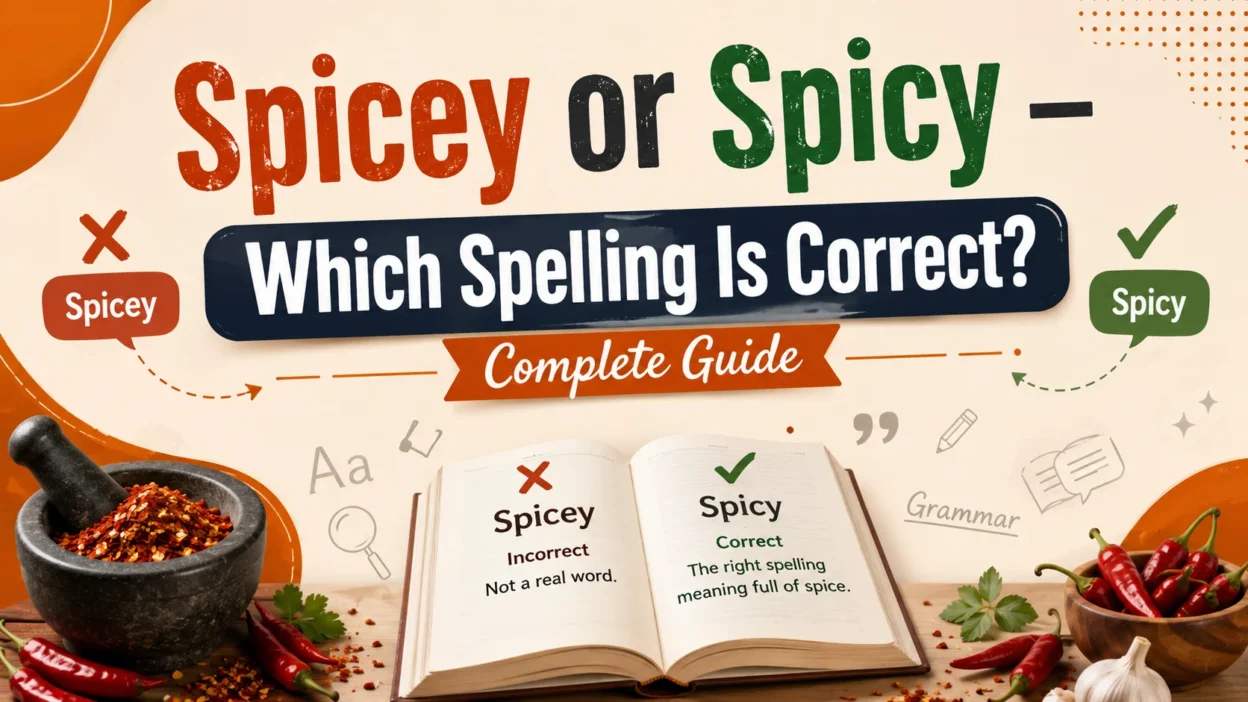
The confusion around spicey or spicy appears in English writing because people connect the word with spice, food, recipes, and spelling rules. Many users mistakenly choose the incorrect version instead of the correct spelling, which can affect clarity, credibility, and professional communication. When writing emails, social media posts, or a simple sentence, using the right word improves your message. For example, “The curry is spicy” clearly shows the proper flavour and meaning, while “spicey” may create errors that confuse readers and reduce confidence. Paying attention to grammar, context, and structure improves writing quality and communication.
Understanding the difference between incorrect and correct spelling helps improve language accuracy and writing skills. Many writers become confused, but learning proper usage through practice, observation, and real examples strengthens communication. In real life, creating blogs, recipes, and online content requires professionalism, grammar rules, textual clarity, and expression mastery. Consistent learning helps learners build stronger English proficiency while keeping their writing polished, readable, and easy to understand.
The word spicy also carries deeper nuances beyond taste. It can describe burning sensations, rich flavor, and a combination of ingredients that creates a strong experience. Some casual writers may question whether “spicey” is acceptable, but understanding semantics, instructional guidance, educational insight, and practical examples improves learning. Whether you are typing a recipe, blog, or social media post, using the correct form through analysis, perspective, and knowledge of language rules helps every reader understand your content better.
Spicey or Spicy – The Quick Answer
The answer is simple:
Spicy is the correct spelling.
Spicey is a common misspelling and should be avoided in standard English writing.
Here is a quick comparison:
| Word | Correct Spelling | Meaning | Example |
| Spicy | ✅ Yes | Having strong flavor, heat, or excitement | This curry is spicy. |
| Spicey | ❌ No | Incorrect spelling | I ordered a spicey dish. |
Many spelling mistakes happen because writers follow pronunciation instead of spelling rules. When people say spicy, they hear the connection to spice, so adding the extra e feels natural.
However, English spelling often changes when words receive new endings.
For example:
- Ice → Icy
- Spice → Spicy
- Noise → Noisy
- Grease → Greasy
The same pattern appears again and again.
Think of the final e as a letter that steps aside to make room for the new ending.
What Does “Spicy” Mean?
The word spicy is an adjective. It describes something that has spice, strong flavor, or a noticeable level of intensity.
Although many people first connect the word with hot food, spicy has grown into a much broader term. Today, people use it in several different ways depending on the situation.
For example:
- A restaurant may advertise a spicy chicken sandwich.
- A friend may share a spicy opinion during a debate.
- A news headline may describe a spicy controversy.
- Someone may call a personality spicy because they are confident and energetic.
The meaning changes slightly, but the main idea remains the same: something that creates a strong reaction.
Definition of Spicy
The standard definition of spicy is:
Having a strong taste or smell because of spices, especially one that creates a warm or hot sensation.
However, the word can also mean:
- Exciting
- Bold
- Interesting
- Unusual
- Provocative
- Full of energy
The context tells you which meaning applies.
For example:
“This salsa is spicy.”
Here, spicy refers to flavor and heat.
“That was a spicy comment during the meeting.”
Here, spicy means bold, surprising, or slightly controversial.
Common Meanings of “Spicy”
Spicy as a Food Description
The most common use of spicy relates to food.
When people describe food as spicy, they usually mean it contains ingredients that create a strong sensation. These ingredients may include:
- Chili peppers
- Black pepper
- Ginger
- Garlic
- Hot sauces
- Strong seasonings
However, spicy does not always mean painfully hot.
A dish can be spicy because it has a rich combination of flavors. Many cuisines use spices to create depth rather than simply increase heat.
For example:
- Indian curry can be spicy because of chili, cumin, turmeric, and other seasonings.
- Thai food may feel spicy because of fresh peppers and herbs.
- Mexican dishes often use spicy sauces and peppers for flavor.
A good cook understands that spicy is about balance, not just heat.
A dish with too much heat can hide other flavors. A well-prepared spicy meal creates excitement while allowing different ingredients to shine.
Spicy as a Description of Personality
Over time, people started using spicy to describe people.
When someone says:
“She has a spicy personality.”
They usually mean the person is:
- Confident
- Funny
- Outspoken
- Energetic
- Unpredictable in an interesting way
It does not usually mean the person is rude or difficult. Instead, it often suggests that they bring excitement to a situation.
For example:
“My new coworker has a spicy personality. She always brings creative ideas to meetings.”
The word adds a playful feeling that stronger words like “aggressive” or “difficult” do not.
Spicy for Opinions and Ideas
Modern English also uses spicy for thoughts, arguments, and discussions.
A spicy opinion usually means an opinion that challenges common beliefs.
Examples:
- “His spicy take on movie endings started a huge discussion.”
- “The article included some spicy opinions about modern technology.”
In this context, spicy means something that creates a reaction.
A safe, ordinary opinion rarely gets called spicy. The word usually appears when an idea feels bold, surprising, or slightly controversial.
Examples of “Spicy” in Real Life
Understanding a word becomes easier when you see how people actually use it.
Here are practical examples:
| Situation | Example Sentence | Meaning |
| Food | This restaurant makes the best spicy noodles. | Hot or strongly flavored |
| Recipe | Add less chili if you don’t want a spicy sauce. | Contains heat |
| Personality | She has a spicy sense of humor. | Bold and energetic |
| Debate | That was a spicy argument about education. | Strong or controversial |
| Social media | The comments section became spicy quickly. | Dramatic or exciting |
Why Do People Write “Spicey”?
The spelling spicey exists because it feels logical.
When people see the word spice, they naturally think:
spice + y = spicey
This happens because English speakers often build new words by adding letters to existing words.
For many words, that approach works.
Examples:
- Quick + ly = quickly
- Slow + ly = slowly
- Kind + ness = kindness
However, English has many spelling rules that change the original word.
The word spicy follows one of those rules.
The Root Cause of the Confusion Between Spicey or Spicy
The confusion comes from the relationship between the noun spice and the adjective spicy.
The original word is:
Spice
When we turn it into an adjective, we add -y.
But English does not keep the silent e.
So:
Spice + y = Spicy
Not:
Spice + y = Spicey
The mistake happens because the incorrect version looks visually connected to the original word.
Many people make the same mistake with similar words:
- Ice → Icey ❌
- Noise → Noisey ❌
- Breeze → Breezey ❌
The correct versions are:
- Icy ✅
- Noisy ✅
- Breezy ✅
The Real Reason Behind the Spelling Change
English removes the final silent e in many situations because keeping it would create unnecessary letters.
The letter e does not change the pronunciation in these examples. It simply remains from the original word.
When adding certain endings, English often removes that extra letter to create a cleaner spelling.
Compare:
Spicey
The extra “e” creates an awkward letter combination.
Spicy
The spelling looks cleaner and matches English patterns.
This small change makes words easier to recognize and write.
Similar Words That Follow the Same Pattern
The spicey or spicy confusion becomes easier when you compare it with familiar examples.
| Base Word | Correct Form | Incorrect Form |
| Spice | Spicy | Spicey |
| Ice | Icy | Icey |
| Noise | Noisy | Noisey |
| Grease | Greasy | Greasey |
| Breeze | Breezy | Breezey |
These examples show a clear pattern:
Remove the silent “e” before adding “y.”
This rule will not solve every English spelling question, but it helps with many common words.
The Grammar Rule Behind “Spicy”
The spelling rule behind spicy is simple:
When a word ends with a silent “e” and you add “-y” to create an adjective, the final “e” is often removed.
The transformation looks like this:
Spice → Remove e → Spic + y → Spicy
The final spelling may seem unusual at first, but it follows a common English pattern.
Why This Rule Exists
English spelling developed over hundreds of years. Many rules exist because writers and speakers needed a consistent way to represent pronunciation.
Removing the extra e helps because:
- The word looks cleaner.
- The pronunciation stays clear.
- Readers recognize the pattern faster.
Language changes over time, but common spelling patterns help people communicate smoothly.
Real-Life Examples of “Spicy” in Sentences
Learning the spelling rule helps, but seeing spicy used naturally makes the word easier to remember. People use this word in many situations, from describing food to talking about personalities and online discussions.
The meaning depends on the context. A spicy meal and a spicy comment do not create the same experience, but both share one idea: they create a noticeable reaction.
Spicy in Food Context
Food is where people use spicy most often. Restaurants, recipes, and food reviews commonly use the word to describe dishes with strong flavors or heat.
Examples:
- “This spicy ramen has a powerful chili flavor.”
- “The chef added spicy peppers to give the dish more depth.”
- “I prefer spicy food because it feels more exciting.”
- “The sauce is spicy but still has a balanced flavor.”
However, spicy does not always mean extremely hot.
A dish can have a mild spicy flavor or an intense spicy kick.
For example:
| Description | Meaning |
| Mildly spicy | A little heat with other flavors still noticeable |
| Medium spicy | A clear level of heat that most people can handle |
| Extremely spicy | A very strong burning sensation |
Many food writers use spicy carefully because heat levels vary from person to person.
A meal that feels spicy to one person may feel mild to someone who regularly eats hot foods.
Spicy When Describing Personality or Behavior
The word spicy has moved beyond the kitchen.
People often use it to describe someone with a strong personality.
For example:
“My younger sister has a spicy personality. She always says what everyone else is thinking.”
Here, spicy does not mean angry or unpleasant. It suggests confidence, humor, and energy.
Other examples:
- “His spicy sense of humor makes every conversation interesting.”
- “She gave a spicy response during the interview.”
- “The comedian’s spicy jokes surprised the audience.”
This use works because spicy food creates a strong reaction, and a bold personality can do the same thing.
Spicy in Online and Casual Communication
Social media has expanded the meaning of spicy even further.
Today, people often describe content as spicy when it is:
- Unexpected
- Dramatic
- Controversial
- Entertaining
- Bold
Examples:
- “That celebrity interview got spicy.”
- “The discussion became spicy after people disagreed.”
- “This post has some spicy comments.”
Online culture often uses food-related words as emotional descriptions.
Other examples include:
- “That’s a hot take.”
- “This conversation is heating up.”
- “Things got heated.”
These expressions connect emotional intensity with physical sensations.
Quick Tip for Remembering “Spicy”
Whenever you hesitate between spicey or spicy, ask yourself:
Would you write icey or icy?
Most people already know icy is correct.
The same pattern applies:
Ice → Icy
Spice → Spicy
The extra “e” disappears.
Spicy in Modern Slang and Internet Culture
The word spicy has become one of the most flexible casual words in modern English.
Originally, it described taste. Now, it can describe anything that adds excitement or creates discussion.
This change is an example of how language naturally evolves.
Words often expand beyond their original meanings because people enjoy using familiar ideas in creative ways.
How “Spicy” Is Used Today
In modern conversations, spicy often describes something interesting or dramatic.
Common examples include:
Spicy Opinions
A spicy opinion is a strong viewpoint that may challenge popular ideas.
Example:
“Her spicy opinion about popular movies started a long conversation.”
The opinion does not have to be wrong. It simply needs to be bold enough to create a reaction.
Spicy Conversations
A conversation becomes spicy when people discuss something exciting, surprising, or controversial.
Example:
“The meeting became spicy when everyone shared their honest thoughts.”
Spicy Entertainment
People also use spicy to describe movies, shows, stories, or events that contain unexpected moments.
Example:
“The new season is much spicier than the previous one.”
Why “Spicy” Works So Well as a Modern Expression
The word works because everyone understands the feeling of spice.
When you taste spicy food, you immediately notice it. It creates a strong experience.
The same idea transfers to:
- Interesting conversations
- Strong opinions
- Memorable personalities
- Unexpected events
The word creates a mental picture without needing a long explanation.
Instead of saying:
“Her personality is energetic, bold, and slightly unpredictable.”
Someone can simply say:
“Her personality is spicy.”
The meaning becomes clear through comparison.
Common Mistakes With Spicey or Spicy
Although spicy is simple once you know the rule, many writers continue to make the same mistake.
Understanding why these mistakes happen helps you avoid them.
Mistake: Keeping the Original Word Too Much
One common mistake happens when writers focus only on the base word.
They think:
Spice → Spicey
The logic feels reasonable, but English spelling rules change some words when endings are added.
Similar examples:
Incorrect:
- Beautyful
Correct:
- Beautiful
Incorrect:
- Truely
Correct:
- Truly
English often changes words instead of simply adding letters.
Mistake: Assuming Every Word Keeps the Silent “E”
Many writers believe the final “e” must always stay.
However, English removes silent letters in many situations.
Examples:
| Base Word | Changed Word |
| Make | Making |
| Write | Writing |
| Use | Using |
| Spice | Spicy |
The final “e” often disappears when it no longer serves a purpose.
Mistake: Using “Spicey” in Professional Writing
Casual spelling mistakes may seem small, but they can affect how readers view your writing.
If you are writing:
- A blog article
- A product description
- A restaurant menu
- A school assignment
- A professional email
using spicy shows accuracy and attention to detail.
Readers may not consciously notice correct spelling, but they often notice incorrect spelling.
A single mistake can distract from otherwise strong writing.
Quick Fix Checklist for Spicey or Spicy
Before publishing your writing, check:
✅ Did you write spicy without the extra “e”?
✅ Are you describing flavor, personality, or an idea?
✅ Does your spelling match standard English usage?
✅ Did you accidentally copy the spelling of “spice”?
A quick review can prevent a simple mistake.
Memory Tricks to Never Misspell Spicy Again
Spelling becomes easier when you connect words with patterns.
Instead of memorizing random letters, remember the relationship between words.
The Easy “Drop the E” Trick
Remember:
The spice loses its “e” when it becomes spicy.
Visualize it like this:
SPICE → SPICY
The final “e” simply disappears.
The Ice and Icy Connection
Most people already know:
Ice → Icy
Nobody writes:
Icey ❌
Because the correct spelling pattern feels familiar.
Now apply the same idea:
Spice → Spicy
This connection makes the spelling much easier.
Another Way to Think About It
Imagine the letter “e” as an extra ingredient.
Too much of an ingredient can ruin a recipe.
In the same way, the extra “e” does not belong in spicy.
The correct recipe is:
Spice + y = Spicy
Spicy vs Spice – What’s the Difference?
Many people confuse spicy with spice because the words look similar.
However, they have different grammatical roles.
Spice: A Noun
The word spice names an ingredient or seasoning.
Examples:
- “Cinnamon is a popular spice.”
- “The recipe needs more spice.”
- “This market sells fresh spices.”
A noun names a person, place, thing, or idea.
Here, spice is the thing.
Spicy: An Adjective
The word spicy describes something.
Examples:
- “The soup is spicy.”
- “I ordered a spicy sandwich.”
- “The sauce has a spicy flavor.”
An adjective gives information about a noun.
The difference:
Spice = the ingredient
Spicy = having the quality of spice
Quick Comparison: Spice vs Spicy
| Word | Grammar Type | Meaning | Example |
| Spice | Noun | Ingredient or seasoning | Chili is a spice. |
| Spicy | Adjective | Full of spice or strong flavor | The chili is spicy. |
Understanding this difference helps you choose the correct word every time.
When Should You Use “Spicy” in Writing?
The word spicy is common, flexible, and widely accepted in everyday English. However, choosing the right place to use it depends on your audience, purpose, and tone.
A food blogger, a restaurant owner, and a journalist may all use spicy, but they might use it in slightly different ways.
The key is understanding what feeling you want the word to create.
Best Use Cases for “Spicy”
Food Reviews and Descriptions
Food writing is the most natural place to use spicy.
Restaurants, recipe creators, and food critics often use the word because it quickly tells readers what to expect.
Examples:
- “The spicy chicken wings have a smoky flavor with a strong chili kick.”
- “This spicy curry combines heat with rich traditional spices.”
- “The restaurant offers both mild and spicy versions of the dish.”
However, professional food writing often works better when it explains the type of spice.
Instead of only writing:
“The dish is spicy.”
A stronger description would be:
“The dish has a bold chili flavor with a slow-building heat.”
The second sentence gives readers a clearer experience.
Casual Conversations
In everyday conversations, spicy feels natural and friendly.
People use it when talking about:
- Food preferences
- Entertainment
- Opinions
- Personal experiences
Examples:
- “Do you like spicy food?”
- “That was a spicy debate.”
- “The new episode had some spicy moments.”
The word works because it is easy to understand and creates a strong image.
Creative Writing
Writers often use spicy to make descriptions more colorful.
For example:
Basic:
“The conversation became interesting.”
More expressive:
“The conversation became spicy when everyone shared their honest opinions.”
The second version creates more energy.
Tone Considerations When Using Spicy
Although spicy is a useful word, it does not fit every situation.
In formal writing, more precise words may communicate better.
For example:
Less formal:
“The politician gave a spicy response.”
More formal:
“The politician gave a controversial response.”
Both sentences work, but they create different impressions.
The word spicy feels:
- Casual
- Modern
- Conversational
- Playful
It may feel too informal for certain professional documents.
Example Comparison: Casual vs Professional Writing
| Situation | Casual Version | Professional Version |
| Food review | This sauce is spicy. | This sauce delivers intense chili flavor. |
| Opinion article | She shared a spicy opinion. | She presented a controversial viewpoint. |
| Event description | The debate got spicy. | The discussion became highly competitive. |
The best writers choose words based on their audience.
Professional Alternatives for “Spicy”
Sometimes, spicy works perfectly. Other times, a more specific word creates a stronger impression.
Using precise language helps readers understand exactly what you mean.
Alternatives for Food Writing
When describing food, you can use:
| Alternative | Meaning |
| Hot | Strong heat sensation |
| Fiery | Very intense heat |
| Peppery | Flavor influenced by pepper |
| Zesty | Bright and fresh flavor |
| Seasoned | Contains noticeable spices |
| Flavorful | Rich taste without focusing only on heat |
Examples:
Instead of:
“The restaurant serves spicy noodles.”
You could write:
“The restaurant serves fiery noodles with a deep chili flavor.”
The second sentence gives a more vivid picture.
Alternatives for Opinions and Ideas
When describing thoughts, discussions, or personalities, consider:
| Alternative | Meaning |
| Bold | Confident and strong |
| Controversial | Likely to create disagreement |
| Provocative | Designed to create discussion |
| Unusual | Different from normal |
| Energetic | Full of enthusiasm |
| Challenging | Makes people think |
Examples:
Spicy:
“The article contains some spicy ideas.”
More specific:
“The article contains some provocative ideas that challenge traditional views.”
Choosing the Right Word Matters
Words carry different emotional effects.
Compare:
Spicy opinion
This sounds casual and slightly playful.
Controversial opinion
This sounds serious and suggests disagreement.
Bold opinion
This sounds confident and positive.
The best choice depends on the message you want to send.
Spicey or Spicy: Quick Reference Guide
For quick review, here are the most important facts.
| Question | Answer |
| Which spelling is correct: spicey or spicy? | Spicy is correct. |
| Is spicey accepted in standard English? | No, it is considered a misspelling. |
| Why does spicy lose the “e”? | English often removes silent “e” before adding certain endings. |
| Is spicy only related to food? | No, it can describe ideas, people, and situations. |
| Can spicy be slang? | Yes, modern speakers use it for exciting or dramatic situations. |
Conclusion:
The difference between spicey or spicy is simple once you understand the spelling rule. The correct form is always spicy, while spicey is a common mistake caused by keeping the original word spice unchanged. English often removes the silent e before adding y, which is why we write spicy instead of spicey.
Using the correct spelling improves your writing, clarity, and professional communication. Whether you are creating recipes, writing a blog, sharing a social media post, or describing a strong opinion, choosing spicy helps your message look accurate and polished. Remember the simple pattern: spice becomes spicy, just like ice becomes icy.
FAQs
Q1: Which spelling is correct, spicey or spicy?
Spicy is the correct spelling in standard English. Spicey is a common misspelling and should be avoided in professional and everyday writing.
Q2: Why does spicy lose the “e” from spice?
The final e disappears because English often removes a silent e before adding certain endings, such as -y. This creates the correct form: spice + y = spicy.
Q3: Can spicy describe something besides food?
Yes. While spicy commonly describes food with strong flavor or heat, it can also describe bold opinions, exciting conversations, dramatic situations, and energetic personalities.
Q4: Is spicey accepted in dictionaries?
No. Standard dictionaries recognize spicy as the correct spelling. Although some people write spicey, it is considered an error in normal English usage.
Q5: How can I remember the spelling of spicy?
Use the simple memory trick: spice becomes spicy. Think about similar examples like ice → icy and noise → noisy to remember that the extra “e” disappears.